Tag Archives: Old Man in Helmand

Lawyers to be prosecuted over Iraq abuse claims


Lawyers to be prosecuted over Iraq abuse claims

Ben Farmer for The Telegraph reports that Leigh Day, a law firm behind hundreds of claims British soldiers abused Iraqis will be prosecuted for professional misconduct over accusations it failed to hand over evidence and paid improper fees of £75,000 to an Iraqi agent handling alleged victims.

On their website Leigh Day claim to be unlike other law firms: ‘We act exclusively for claimants who’ve been injured or treated unlawfully by others.’ Is there a hidden message in their claims? I think perhaps there is.
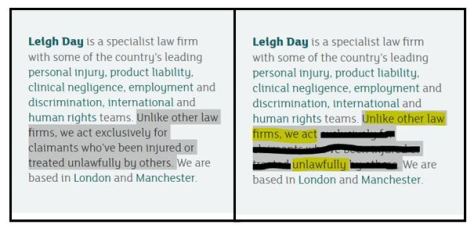
We act unlawfully

The charges against Leigh Day date back to 2004. They may take some comfort in knowing that perhaps they inspired others to jump on the Angrezi gravy train.

“I WAS ALONE in the J9 cell when the secure telephone I shared with the other dozen or so occupants starting ringing. As soon as I picked up a guttural voice announced without preamble: Iz Man at Gate.

It was a member or the Bosnian Guard Force informing me that we had a walk‑in visitor at the front gate. This was a reasonably frequent occurrence and in most cases would be a local national come to make representation to ISAF on some matter, most commonly to seek compensation for damage to property. It was well known that ISAF would reimburse citizens for any damage to crops, property or livestock for which it was responsible. In the early days of the Afghan campaign commanders would carry a quantity of hard currency with them on operations and pay out according to their own individual assessment.

Carrying large amounts of cash on the battlefield presents some obvious problems and as the campaign wore on the British professionalised their approach to the payment of compensation. Instead of cash, commanders began carrying claims forms which they passed to locals for presentation at any of the main British bases where the Military Stabilisation and Support Group (MSSG) would assess their claim and pay, where appropriate, at a predetermined but still generous rate.

Naturally the Afghans stepped up their game in response, and enterprising individuals, much like ambulance chasing law firms in the West, could be hired in the Gereshk bazaar to help citizens with their claims. These ‘consultants’ provided a range of services, including basic help with the filling out of forms, the taking of digital photos to help support claims and even representation at the weekly ‘Compensation Clinics’ run by the MSSG.

Like everyone else in theatre the MSSG assessors rotated every six months or so. This created an opportunity for those less fortunate citizens who lacked a genuine claim for compensation to jump on the Angrezi gravy train. Some less scrupulous consultants offered for sale in the bazaar photographs from historic cases which could be resubmitted in support of a fresh claim to a new assessor. I’m sure these claims consultants were obliged by their regulatory body to advise their clients that past performance was no guarantee of future success. I’m also sure that they demanded from their clients a premium for this particular service, while implying the near certainty of a payout. But this was not always the result. A number of the MSSG operators I spoke to, while grudgingly admiring this Afghan enterprise, routinely rejected claims from multiple different claimants that relied on identical photographs as supporting evidence.

I was not authorised to assess claims. If the visitor was seeking compensation there was little I could do for him other than advise him to attend a compensation clinic. However, since I was alone in the J9 cell, it fell to me to see what he wanted. The balance of probabilities suggested that this particular visitor was unlikely to be a suicide bomber, or a Taliban assassin, but I laboriously donned my body armour and checked chamber on my Sig 9mm pistol just in case.”

If Leigh Day are found to have acted unlawfully I trust they will receive a fine that is proportionate to the £30m cost of the public enquiry.

SPIN ZHIRA: Old Man in Helmand is available as an Amazon Kindle e-book

SPIN ZHIRA: Old Man in Helmand is the unauthorised, unvarnished and irreverent story of one man’s midlife crisis on the front line of the most dangerous district in Afghanistan where the locals haven’t forgiven the British for the occupation of 1842 or for the Russian Invasion of 1979. Of course, all infidels look the same so you can’t really tell them apart.
Radio-in-a-box (RIAB)

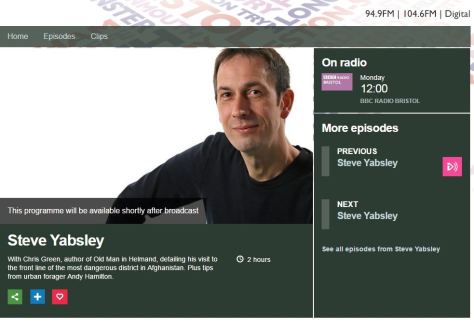
Steve Yabsley

I’m joining Steve Yabsley’s lunchtime show tomorrow on BBC Radio Bristol. I have some prior radio experience but it’s not very positive:

“The radio‑in‑a‑box was exactly that. A rather large and cumbersome box which contained ruggedised tape and CD decks, together with sophisticated recording and broadcasting equipment. Requiring only the addition of electrical power, an antenna and a willing DJ, it contained all that was needed to set up a new radio station.

I’d been introduced to the RIAB on the PsyOps course I’d attended at the Defence Intelligence and Security Centre in Chicksands, Bedfordshire. Due to the very high rates of illiteracy in Afghanistan, or perhaps due to the very low number of Pashtu speakers amongst ISAF soldiers, radio was considered an essential communications tool by both British and American forces.

RIABs had first been used in Afghanistan in 2005 at a time when the Taliban were assessed to be winning the public relations battle. At the time ISAF had no means to counter Taliban propaganda or to communicate anti‑Taliban and anti‑al‑Qaeda messages of its own. The RIAB was the answer, enabling ISAF to broadcast its version of events to a large, often remote audience.

By the time I arrived in Helmand the RIAB was the psyopers¹ weapon of choice and a network of radio transmitters had been set up across the province using local Afghan DJs to broadcast information and host call‑in shows. The psyopers liked to call their creation ‘Radio Tamadoon’, but all the Afghans I ever met called it what it was, Radio ISAF. To complement the transmitters, wind‑up radios had been handed out to local nationals. Although I was not prepared to vouch for the reliability of the statistics, it was alleged that 92% of Helmand Province’s 1.5 million inhabitants listened to the radio every day.

Certainly thousands of radios had already been distributed and I gave away hundreds more on my FFUI² patrols, but I never saw any of the locals actually using the radios or listening to Radio ISAF. All those who eagerly accepted the free radios I handed out assured me that they tuned in every day, but I was sceptical. I’d grown used to locals telling me what they thought I wanted to hear so I took to carrying one of the wind‑ups in my pack and attempting to tune into the RIAB on my patrols. To my surprise, despite maps of the province produced by the PsyOps Group which outlined antenna reach and indicated almost total coverage in our AO, I discovered that reception outside Gereshk was patchy at best and non‑existent in many areas.

In contrast it was easy enough to tune into BFBS Radio, the English language station for UK troops, almost everywhere I travelled. BFBS was of course staffed by civilians, all of whom were professionals in the broadcasting industry, while the RIAB was staffed by soldiers, like me, with little if any prior experience.

Nonetheless, Thor and I invested a lot of time trying to improve the station programming and make it less blatantly an ISAF propaganda tool by inviting GIRoA officials, ANA commanders, Mullahs and other local dignitaries to conduct radio shows. We even had a go at healthcare and agricultural advice programming, but neither of us had any experience in running a radio station and there was no budget to produce these shows. Our efforts, while initially enthusiastic and well intentioned, were amateurish at best and we quickly ran out of goodwill and content to fill our ambitious schedule.

It was claimed that some RIAB DJs had as many as 50,000 listeners, but I guessed that poor reception and dodgy scheduling was having a negative impact on our figures and I started scanning the phone‑in reports produced after each show. Despite the statistics being bandied about by the PsyOps Group, I discovered that most of the calls we received came from the same half dozen callers. Even Sultaan, the irrepressibly optimistic District Communications Advisor became disillusioned with the RIAB and stopped turning up to host the weekly live phone‑in show that Thor and I had given him.

When I discussed my reservations with Owen, our Royal Marines Cultural Advisor and one of only a handful of fluent Pashtu speakers in Task Force Helmand, he helpfully pointed out that one of my supposedly local DJs was in fact from another part of Afghanistan where they spoke a different dialect from the Helmandis. This embarrassing oversight may have had something to do with our rather poor performance.

But there was another even more compelling reason. I’d read in an intelligence report that ownership of an ISAF radio could be injurious to human health. In the contested area in which we operated locals risked a severe beating from the Taliban if they were found to be in possession of one of the free wind‑ups we were handing out, although I’d observed that these were still eagerly accepted in all but the most hard‑line areas. All my evidence may have been circumstantial but it still pointed to an obvious conclusion. Our woeful reception and lamentable programming were quite simply not worth a beating. Although I couldn’t prove it, I rather suspected that the majority of the radios I handed out ended up, still in their original packaging, in the markets and bazaars of other more permissive districts.

Perhaps the RIAB was not quite as effective a weapon in the communications war as the PsyOps Group were claiming. It seemed perfectly possible to me that the POG were psyoping the home team by overstating the role and value of the RIAB to the counter‑insurgency.”


SPIN ZHIRA: Old Man in Helmand is available as an Amazon Kindle e-book

SPIN ZHIRA: Old Man in Helmand is the unauthorised, unvarnished and irreverent story of one man’s midlife crisis on the front line of the most dangerous district in Afghanistan where the locals haven’t forgiven the British for the occupation of 1842 or for the Russian Invasion of 1979. Of course, all infidels look the same so you can’t really tell them apart.
¹Psyoper: A psychological operations practitioner

²FFUI: Find, Feel, Understand, Inform. In January 2010, Major General Michael T. Flynn USA wrote an influential paper titled Fixing Intel: A blueprint for making intelligence relevant in Afghanistan. His paper recommended sweeping changes to the way the intelligence community thinks about itself – from a focus on the enemy to a focus on the people of Afghanistan. This involved modifying the five components of the kinetic targeting approach: find, fix, finish, exploit and analyze into a non-kinetic social engineering construct: find, feel, understand, inform.

More time in the office?

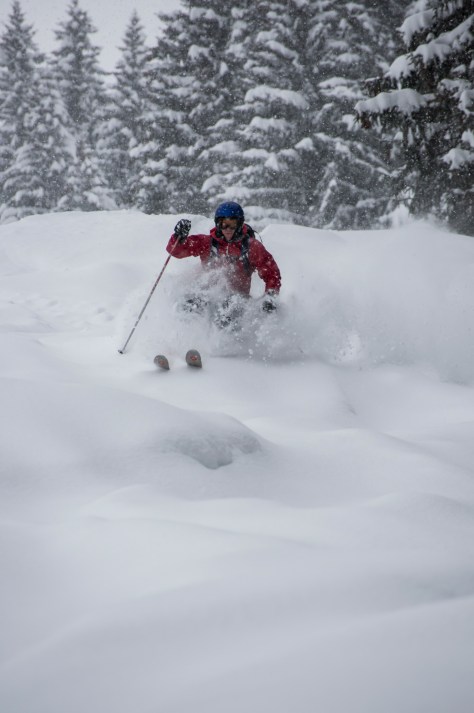
Author in Fresh Pow

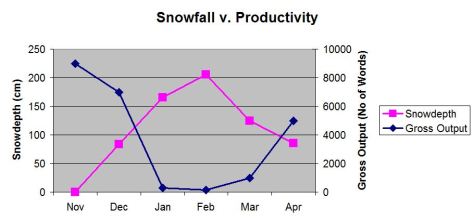
When I first set out to write my book during the 2012/13 ski season, a season which coincidentally saw the heaviest accumulated snowfall in the French Alps for over 70 years  I naively imagined it would take me three months.

In the end it has taken a little over three years, during which time I have discovered a statistically significant inverse correlation between fresh snowfall and writing productivity.

Snowfall v Productivity

I’ve lost count of the number of writing hours sacrificed in the search for fresh powder but I don’t regret a single one of them. No-one looks back from their death-bed and wishes they’d spent more time in the office. Do they?

SPIN ZHIRA: Old Man in Helmand is available as an Amazon Kindle e-book

SPIN ZHIRA: Old Man in Helmand is the unauthorised, unvarnished and irreverent story of one man’s midlife crisis on the front line of the most dangerous district in Afghanistan where the locals haven’t forgiven the British for the occupation of 1842 or for the Russian Invasion of 1979. Of course, all infidels look the same so you can’t really tell them apart.
JOHNNY TELLS IT LIKE IT IS

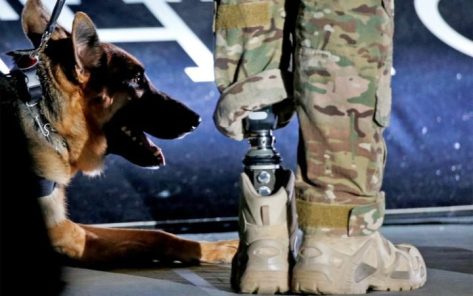
Invictus Games opening ceremony

Some Westminster insiders want me to shut up about veterans’ care. Here’s why I won’t

In the wake of the Invictus Games, Johnny Mercer MP stands up for injured veterans in his article for The Telegraph saying: ‘We know we owe you for the sacrifices you made in defence of the freedoms that we enjoy. We have a duty to you. Come forward; don’t suffer in silence. You gave the best years of your life in Service to this great Nation, in the proud traditions of your forebears.’

I could not agree more, but there’s a very good reason why veterans need a champion like Johnny and why other government ministers are urging him to drop the issue:

“Just like everyone else in the battlegroup, I hoped for the best and planned for the worst. In view of the very real and obvious dangers inherent in dismounted close combat I took out life insurance with the MoD’s approved provider. I wasn’t entirely certain if I was insuring myself against the risks of death or injury in the service of my country, or against the inadequacies of the long‑term care I would receive from the State in this second eventuality.

After more than ten years of conflict and a willingness by successive British governments to commit soldiers to combat, it is still a shameful reality that soldiers wounded in the service of their country are not adequately cared for by the State. They must rely instead on the generosity of the public through charities such as Help for Heroes to provide not only resources for their immediate rehabilitation as they recover from their injuries, but also for the long‑term care that many will need throughout the rest of their lives.

It was most unedifying to learn of the personal greed of our political masters in the Parliamentary expenses scandal that engulfed British politics in 2009–10. At this time, according to official statistics released by the MoD, eight British soldiers a month were dying in Afghanistan. A further 13 were very seriously wounded, sustaining injuries that would change the course of the rest of their lives. It is notable that our political leaders at almost every level of governance will show public support for the men and women of the Armed Services – yet still drag their heels when it comes to ensuring that those who make the ultimate sacrifice receive adequate financial support from a grateful country.”

Johnny concludes: ‘Should we have done more as a Government in this sector [veterans’ care] to facilitate it and “guarantee it” over the years? Undoubtedly yes. Are we getting better? Is this PM committed to it? Yes.’

I hope you’re right Johnny but don’t stop raising the issue at PMQs.

SPIN ZHIRA: Old Man in Helmand is available as an Amazon Kindle e-book

SPIN ZHIRA: Old Man in Helmand is the unauthorised, unvarnished and irreverent story of one man’s midlife crisis on the front line of the most dangerous district in Afghanistan where the locals haven’t forgiven the British for the occupation of 1842 or for the Russian Invasion of 1979. Of course, all infidels look the same so you can’t really tell them apart.
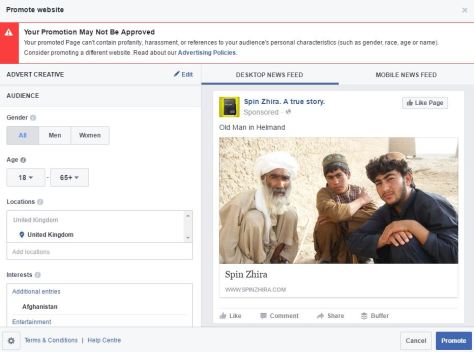
Your Promotion May Not Be Approved

Facebook Promotion

Facebook continues to block my promotions and I’m beginning to think I must have been blacklisted. Ironically, Facebook kept me sane in Afghanistan, now it’s driving me nuts.

“Being a man of upper middle age, I hadn’t really got the point of Facebook before Afghanistan. Now it had become a lifeline to a world without Hesco. A world where people, in the normal course of events, were not routinely and painstakingly planning to kill each other.

Instead they were posting pictures of the places they’d visited at the weekend, of their kids winning prizes at school, or even of the maddening commute to work they’d endured on Monday morning.

Sitting down at one of the battered and bruised keyboards I enjoyed my allotted 30 minutes of internet time, living vicariously through the delicious morsels of normality that my friends and family served up from all over the globe. With a like, comment or share, I was able to join them in that moment, and in doing so let them know I was alive and well.

Facebook now made perfect sense but, ironically, it could not bring me news of my own family. Unfriended by Jane, I assume to avoid sharing with me any potentially embarrassing pictures of her new life with her new partner, she had also denied me further news of Harry and Alfie.”

SPIN ZHIRA: Old Man in Helmand is available as an Amazon Kindle e-book

SPIN ZHIRA: Old Man in Helmand is the unauthorised, unvarnished and irreverent story of one man’s midlife crisis on the front line of the most dangerous district in Afghanistan where the locals haven’t forgiven the British for the occupation of 1842 or for the Russian Invasion of 1979. Of course, all infidels look the same so you can’t really tell them apart.
1000’s flee fighting

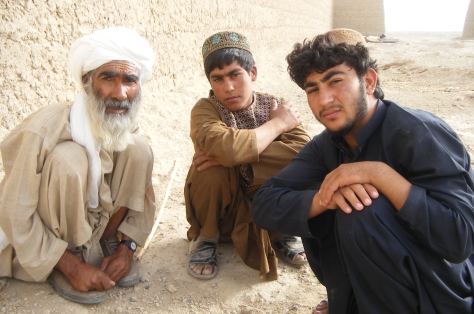
Father and sons, Zumbalay

Displacement due to conflict within Afghanistan increased by 40% from 2014 to 2015, and this year could see another increase.

According to an OHCA report published yesterday, about 118,000 people have already fled their homes since the beginning of the year. 1,000 Afghans Flee Fighting Every Day: UN.

In 2009, General Stanley McChrystal observed that “Destroying a home or property jeopardises the livelihood of an entire family – and creates more insurgents.” I certainly saw evidence of this:

“Although Mirajdin invoked Allah in his endeavours to kill British servicemen his was not a Holy War. Mirajdin was a proud Muslim, but not a Jihadist nor even a Talib. He did not fight for reasons of faith or ideology.

Nor was his an intergenerational struggle against a colonial oppressor, even though his forebears had routed the British at the battle of Maiwand. As a wide‑eyed toddler at his grandfather’s knee, Mirajdin had listened in awe to bloody tales of the last stand of the 66th (Berkshire) Regiment of Foot at the Mundabad Ravine, not far from where he now lay.

These stories, passed down the generations by the village spin zhiras, had nothing but praise and admiration for the bravery of the Angrezis who’d fought to the last man in the defence of their Colours. It was said these men, surrounded by thousands, died with their faces to the enemy, fighting to the death and their courage was the wonder of all who saw it.

It was a courage Mirajdin did not recognise in the men who now came to avenge them, hiding as they did in armoured vehicles while raining death and destruction from the sky.

Although Mirajdin, along with many others, was of the firm conviction that the British had returned after 150 years to avenge their ancestors, his own motives for opposing them dated back to a much earlier time. As an Ishaqzai tribesman, Mirajdin fought to resolve an injustice imposed upon his people over two and a half centuries earlier when Ahmed Shah first united the Pashtun clans of Afghanistan and founded the Durrani Dynasty.

Prior to 1747 the Ishaqzai had been the dominant Pashtu tribe in Helmand. Under the Durrani Confederation their fortunes had waned and another tribe, the Barakzai had come to prominence. Loss of power and prestige had resulted in a loss of livestock, many lost their nomadic lifestyle, and some were also deprived of their respected status as warriors.

Impoverished Ishaqzai nomads were forced by circumstance to become farmers and earned the derogatory nickname Sogzai or Vegetable People. Ironically perhaps, the Vegetable People had learned to grow poppy and, under the Taliban, their fortunes had revived.

Mirajdin now fought the British not from religious zeal, or from racial hatred, but because the British, following the fall of the Taliban, had been duped by the Barakzai leadership into supporting their efforts to take control of the opium trade in Helmand. The British, and the Americans before them, had empowered the Barakzai by awarding them lucrative construction and security contracts. In return, the Barakzai had fooled the British into believing their old tribal rivals were insurgents, or Taliban.

In 2006, in the face of Barakzai intimidation, with the unwitting collusion of British troops, Mirajdin’s family had been forced to abandon their home to the north‑east of Gereshk and resettle in less fertile lands outside the green zone. Seen through the lens of a centuries‑old intertribal rivalry, Mirajdin had endured this humiliation as a teenager and had silently vowed to restore his family and his people’s honour. Six years later, lying in the dust beside the road, with pounding heart and trembling fingers, he was just moments from realising his pledge.

If God willed it.

Mirajdin was no more than an accidental insurgent. He fought the British simply because they were his rival’s allies. His forefathers had contested Barakzai domination long before the arrival of the Angrezi kafirs, and his descendants would continue to do so long after they had departed.”

SPIN ZHIRA: Old Man in Helmand is available as an Amazon Kindle e-book

SPIN ZHIRA: Old Man in Helmand is the unauthorised, unvarnished and irreverent story of one man’s midlife crisis on the front line of the most dangerous district in Afghanistan where the locals haven’t forgiven the British for the occupation of 1842 or for the Russian Invasion of 1979. Of course, all infidels look the same so you can’t really tell them apart.

Seek Out Danger

ACOG optical weapon sight, Saidan

I discovered James Elroy Flecker’s verse play Hassan (1922) at the weekend. His words ring true, perhaps because they reference snow covered mountains or perhaps because they so perfectly describe my mid life crisis. Ironically, they are also much admired by the Special Air Service, with whom I was mostly at loggerheads throughout my time in Afghanistan.

Go as a pilgrim and seek out danger
far from the comfort
and the well lit avenues of life.

Pit your every soul against the unknown
and seek stimulation in the comfort of the brave.

Experience cold, hunger, heat and thirst
and survive to see another challenge and another dawn.

Only then will you be at peace with yourself
and be able to know and to say;

“I look down the farthest side of the mountain,
fulfilled and understanding all,
and truly content that I lived a full life
and one that was my own choice.”

We are the Pilgrims, master; we shall go always a little further;
it may be beyond that last blue mountain barred with snow
across that angry or that glimmering sea.

SPIN ZHIRA: Old Man in Helmand is available as an Amazon Kindle e-book

SPIN ZHIRA: Old Man in Helmand is the unauthorised, unvarnished and irreverent story of one man’s midlife crisis on the front line of the most dangerous district in Afghanistan where the locals haven’t forgiven the British for the occupation of 1842 or for the Russian Invasion of 1979. Of course, all infidels look the same so you can’t really tell them apart.
Highway to Hell


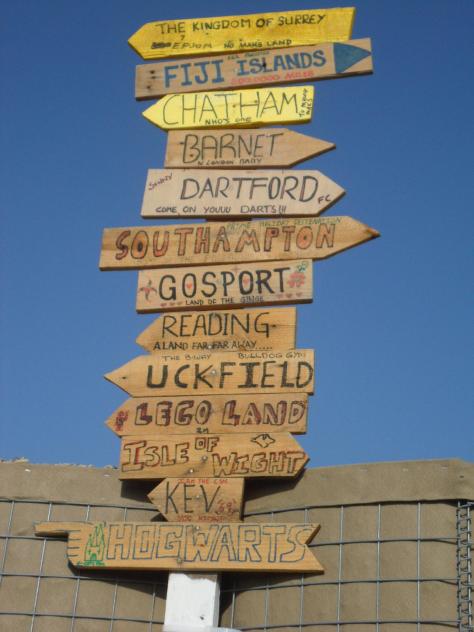
A long way from Legoland

Taliban Cut Off Afghan Highway Linking Kabul to Northern Gateways – The New York Times

The New York Times reports that the Kabul government is losing control of Afghanistan’s Highway network – built by international donors at a cost of $3 billion. I can’t say I’m surprised:

“The Kandahar–Herat highway forms part of Highway One, which itself is part of the southern section of a 2,200km ring road inside Afghanistan connecting the cities of Mazari Sharif, Kabul, Ghazni, Kandahar, Farah, and Herat.

Originally constructed by the Soviets in the 1960s, hundreds of millions of dollars of international aid, mostly from the US, Saudi Arabia and Japan, have been invested in its reconstruction following ISAF intervention in the country. In 2005, then US ambassador to Afghanistan, Zalmay Khalilzad called the highway ‘a symbol of Afghan renewal and progress’. But in some quarters it is also known as the Highway to Hell.

Anyone wishing to travel the highway must pay illegal tolls, not only at the many ANA and AUP checkpoints along its route, but also to armed gangs and brigands, some of whom claim to be Taliban, who control its more remote stretches.

Kidnappings and killings of those unable or unwilling to pay are common, as are attacks on both military and civilian ISAF convoys that use the route. The road is heavily cratered in places and littered with burned out trucks, further hazards for the unwary traveller. In addition to logistics convoys, locals working with the government, aid agencies, and those connected to Westerners are also frequently targeted and killed.

Travelling at night is not recommended. Some sections of the highway have solar powered street lighting installed, but the photovoltaic panels have been stolen long ago. Lone headlights attract the attention of local bandits. Approaching one of the many ANA checkpoints after dark is likely to attract automatic gunfire from nervous soldiers who, with good reason, fear suicide bombers.”

SPIN ZHIRA: Old Man in Helmand is available as an Amazon Kindle e-book

SPIN ZHIRA: Old Man in Helmand is the unauthorised, unvarnished and irreverent story of one man’s midlife crisis on the front line of the most dangerous district in Afghanistan where the locals haven’t forgiven the British for the occupation of 1842 or for the Russian Invasion of 1979. Of course, all infidels look the same so you can’t really tell them apart.

Redacted#2

Front cover for Facebook

When I first set out to write a book about my experiences in Afghanistan I was informed by Army Media Communications that it could not:

Criticise our allies, other Government Departments or past/current Prime Ministers.

Include anything that would undermine the Army’s reputation.

Since I planned to do all these things it became immediately apparent that, in order to escape censorship, I would have to leave the army reserve.

I now find myself subject to censorship from an unexpected quarter.

Facebook.

Initially there was some, not unreasonable, objection to the doodle on the front cover of my notebook. This was resolved with gaffer tape.

However, the Facebook censors have also determined that the book’s title is unsuitable. With good reason Facebook insists that “posts can’t contain profanity, harassment, or references to your audience’s personal characteristics (such as gender, race, age or name).” 

So, it turns out that ‘Old Man’ was a little too personal and has now been redacted from the Facebook page name and profile image. However, the book itself remains unapologetically unchanged.

Visit the Amazon Kindle store to see what all the fuss is about.

I can’t help but wonder what Mark Zuckerberg would make of this? Facemash, the precursor to Facebook was shut down after it was deemed inappropriate.

SPIN ZHIRA: Old Man in Helmand is the unauthorised, unvarnished and irreverent story of one man’s midlife crisis on the front line of the most dangerous district in Afghanistan where the locals haven’t forgiven the British for the occupation of 1842 or for the Russian Invasion of 1979. Of course, all infidels look the same so you can’t really tell them apart.
Improvised Explosive Device


Yesterday, as the Invictus Games were concluding in Orlando,  I joined an email thread between two readers, one in London and the other in Thailand (my only reader in Thailand so you know who you are). They were discussing Improvised Explosive Devices (IEDs). It was impossible not to reflect that many of the Invictus competitors are the victims of IEDs and have overcome terrible injuries to compete for their country. In my book I have tried to provide an insight into what all soldiers endured as they patrolled the badlands of Helmand Province:

“As the Grenadiers or fighting Ribs1 of Inkerman Company knew only too well, living with the constant possibility that your every next step may trigger an IED slowly and inevitably degrades the human spirit. It pervades every waking moment and is a constant and exhausting factor. Every breath must be carefully savoured lest it be your last. Every footfall must be critically considered and evaluated before being placed. Each tread is committed with unyielding trepidation. The euphoria of one safe step is immediately replaced by apprehension at the next and so on and so on until …

According to Aristotle, ‘Fear is pain arising from the anticipation of evil.’ Not being as erudite as the great Greek polymath, for me, fear is the ever‑present possibility that my fellow man has carefully concealed a yellow palm oil container packed with a volatile mixture of ammonium nitrate and aluminium in the ground beneath my feet. It is the screaming anticipation that my very next step will initiate this crude mixture and a dark and powerful blast will remove my legs and my manhood and leave me bloodied and broken in the dirt.

As friends and colleagues fall victim to these devices and are forever mutilated or killed in circumstances or locations you have visited yourself, it becomes possible to reflect not that you have been lucky, but that you must be next. It’s a conviction that slowly and inexorably takes hold in the darkest recesses of your exhausted mind and grows like a malignant cancer.

During the course of my patrols in the Gap I witnessed young Guardsmen so overcome with fear that they would vomit at the front gates of the base before bravely stepping off on a patrol they have convinced themselves will be their last. I have also seen men so exhausted by constant vigilance that they lose all reason and stumble about blindly, no longer caring if they live or die.

Both are equally distressing to observe. But in this I was not always a mere observer.

On one patrol I was myself so overwhelmed by the certainty that I was about to take my last few steps on this earth that I became rooted to the spot unable to move either forward or back. It took the gentle and patient persuasion of a better man half my age to guide me, temporarily broken and useless, to safety.

I would hear IEDs detonated by other callsigns, sometimes less than a kilometre distant. Or I would join a platoon for a few days, to learn soon afterwards that one of their number had been grievously wounded.

One device claimed the legs of another London Regiment soldier, Lance Corporal John Wilson with whom I’d trained and prepared for deployment, another took the foot of Jay, an SF soldier whom I’d got to know. Jay had postponed his end of tour date when yet more faults on the ageing RAF Tristar fleet had delayed his replacement’s arrival into theatre.

I tried to convince him that he didn’t need to go back out on the ground but he ignored my advice. When the news came through that his patrol had been whacked by an IED and had a serious casualty I instantly feared it must be him, and so it proved to be. Some reckoned he’d been lucky – the device only partially detonated and his injuries could have been much worse – but I knew that Jay’s luck had run out with his chuff chart2”

SPIN ZHIRA: Old Man in Helmand is available as an Amazon Kindle e-book

SPIN ZHIRA: Old Man in Helmand is the unauthorised, unvarnished and irreverent story of one man’s midlife crisis on the front line of the most dangerous district in Afghanistan where the locals haven’t forgiven the British for the occupation of 1842 or for the Russian Invasion of 1979. Of course, all infidels look the same so you can’t really tell them apart.

Yellow palm oil IED1Ribs/fighting Ribs: Inkerman Company, First Battalion The Grenadier Guards are known as the Ribs or fighting Ribs after their predecessors took part in the Anglo-Dutch Wars (1652-74) as marines, accommodated in the ship’s hold amongst the ribs.

2Chuff Chart: A chart or calendar used by servicemen and woman to count down the days until the end of a tour of duty.