Tag Archives: British Army

Defence Chiefs accused of giving ISIS a ‘hit list’.

Following this morning’s news in The Times that the MoD, in its infinite wisdom, has published the details of every regular officer, reservist officer and university trainee on a government website, the Daily Mail have now picked up the story. My poor ex-father-in-law will be choking over his dinner:

‘I took out my patrol camera and started photographing anything I thought might be useful for the report I would be writing on my return. I’d got into the practice of doing this early on in the tour and had found it to be invaluable. Engrossed in this task I turned the corner of the compound and almost walked into Haji Jalander, the old Mujahideen I’d interviewed back in MOB Price. Somehow he’d slipped through the Danish cordon unnoticed.

Although I knew Haji was from Zumbalay it hadn’t occurred to me that I might meet him here. But my surprise was nothing compared to his. The last time we’d met I was pretty sure Haji was up for killing me. I certainly wouldn’t have been the first khareji he’d put to death, but once again I had the advantage on him. I was armed with more than just a camera, while he had only his trusty radiator key on its slender brass chain.

Finding my wits I wished him ‘As‑salaam Alaykoum’, to which he instinctively replied before he could check himself, ‘Alaykoum As‑salaam’. Pleasantries over we stood and stared at each other for a few moments before we were joined by one of the Tiger Team lads who spoke a little English.

I waited patiently while they spoke rapid‑fire Pashtu. It was clear the Tiger was getting the full backstory on how Haji and I came to be acquainted. Haji went on at length and the more he spoke the more the fierce old Muj was winding himself up. I was reminded of my soon‑to‑be‑ex father‑in‑law who had a similar capacity to raise his own blood pressure to dangerous levels simply by reading The Daily Mail.

Eventually Haji ran out of steam and the Tiger turned to me and skilfully translated his lengthy diatribe into four words: ‘You know this man?’

I acknowledged that I did and asked him to enquire after Haji’s son‑in‑law. Had he returned? This was obviously a mistake as it set Haji off on another long stream of uninterrupted invective.

The young Afghan soldier was clearly a master of the paraphrase. Laughing a little too nervously for my liking, he translated this last tirade:

‘He says you will die here today, the Taliban will not let you leave alive.’

SPIN ZHIRA: Old Man in Helmand is the unauthorised, unvarnished and irreverent story of one man’s midlife crisis on the front line of the most dangerous district in Afghanistan where the locals haven’t forgiven the British for the occupation of 1842 or for the Russian Invasion of 1979. Of course, all infidels look the same so you can’t really tell them apart.

 

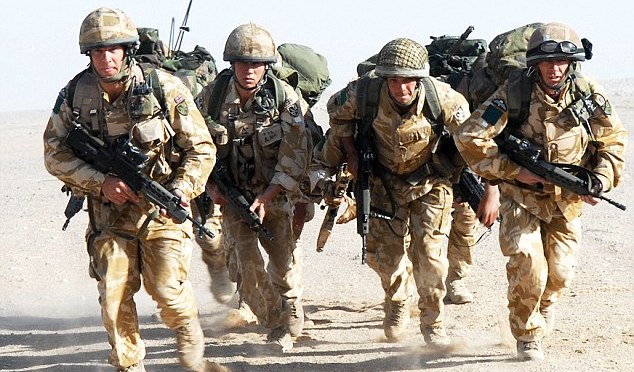
ISIS GIVEN HITLIST

Deborah Haynes reveals in The Times today that the MoD, in its infinite wisdom, has published the details of every regular officer, reservist officer and university trainee on a government website.

I first met Deborah in Camp Bastion in 2012 when my unauthorised and unmonitored conversation with her caused the army media team who were handling her visit to get into a flap that I may have said something ‘off-message’.

When she called yesterday to ask me how I felt about the MoD’s public disclosure of my name, along with 20,000 others, I was a little taken aback. I assured her she must be mistaken. After the murder of Lee Rigby in 2013, servicemen have been repeatedly warned about the dangers of revealing their military service on social media and are cautioned against wearing their uniforms in public. Following this guidance and the very real risk of being targeted by Islamic terrorists, the MoD would never be so cavalier with our personal security.

I should have known better. This is, after all, the same ministry that continued to issue Lariam to troops long after the manufacturer had warned of the mental health risks associated with the drug. The same ministry that awarded Sir Bernard Grey a £45,000 bonus after he ran up an £23,000 expenses bill. And the same ministry that has paid £440 million in a failed recruitment drive.

Our names were published without our consent following a freedom of information request submitted, presumably, by Abu Bakr al-Baghdadi or one of his flunkies. Now that Deborah has exposed the blunder it’s comforting to know that the MoD has no plans to remove the list, insisting that ‘the security of our people is our foremost concern’.

SPIN ZHIRA: Old Man in Helmand is the unauthorised, unvarnished and irreverent story of one man’s midlife crisis on the front line of the most dangerous district in Afghanistan where the locals haven’t forgiven the British for the occupation of 1842 or for the Russian Invasion of 1979. Of course, all infidels look the same so you can’t really tell them apart.
5,313 IED events in Helmand.

According to Forces TV, the MoD has released a one-off report detailing the injuries suffered by UK troops during Operation Herrick in Helmand. Improvised explosive devices (IEDs) accounted for 5,313 ‘events’ resulting in traumatic injury to 1, 982 British service personnel.

By the time I arrived in Afghanistan in January 2012 the IED was the Taliban weapon of choice. In nine months the combined Afghan, Danish and British force with whom I worked suffered 117 IED strikes and discovered a further 241 IEDs:

‘As the Grenadiers or fighting Ribs of Inkerman Company knew only too well, living with the constant possibility that your every next step may trigger an IED slowly and inevitably degrades the human spirit. It pervades every waking moment and is a constant and exhausting factor. Every breath must be carefully savoured lest it be your last. Every footfall must be critically considered and evaluated before being placed. Each tread is committed with unyielding trepidation. The euphoria of one safe step is immediately replaced by apprehension at the next and so on and so on until …

According to Aristotle, “Fear is pain arising from the anticipation of evil.” Not being as erudite as the great Greek polymath, for me, fear is the ever‑present possibility that my fellow man has carefully concealed a yellow palm oil container packed with a volatile mixture of ammonium nitrate and aluminium in the ground beneath my feet. It is the screaming anticipation that my very next step will initiate this crude mixture and a dark and powerful blast will remove my legs and my manhood and leave me bloodied and broken in the dirt.

As friends and colleagues fall victim to these devices and are forever mutilated or killed in circumstances or locations you have visited yourself, it becomes possible to reflect not that you have been lucky, but that you must be next. It’s a conviction that slowly and inexorably takes hold in the darkest recesses of your exhausted mind and grows like a malignant cancer.

During the course of my patrols in the Gap I witnessed young Guardsmen so overcome with fear that they would vomit at the front gates of the base before bravely stepping off on a patrol they have convinced themselves will be their last. I have also seen men so exhausted by constant vigilance that they lose all reason and stumble about blindly, no longer caring if they live or die.

Both are equally distressing to observe. But in this I was not always a mere observer.

On one patrol I was myself so overwhelmed by the certainty that I was about to take my last few steps on this earth that I became rooted to the spot unable to move either forward or back. It took the gentle and patient persuasion of a better man half my age to guide me, temporarily broken and useless, to safety.

I would hear IEDs detonated by other callsigns, sometimes less than a kilometre distant. Or I would join a platoon for a few days, to learn soon afterwards that one of their number had been grievously wounded.

One device claimed the legs of another London Regiment soldier, Lance Corporal John Wilson with whom I’d trained and prepared for deployment, another took the foot of Jay, an SF soldier whom I’d got to know. Jay had postponed his end of tour date when yet more faults on the ageing RAF Tristar fleet had delayed his replacement’s arrival into theatre.

I tried to convince him that he didn’t need to go back out on the ground but he ignored my advice. When the news came through that his patrol had been whacked by an IED and had a serious casualty I instantly feared it must be him, and so it proved to be. Some reckoned he’d been lucky – the device only partially detonated and his injuries could have been much worse – but I knew that Jay’s luck had run out with his chuff chart.’

SPIN ZHIRA: Old Man in Helmand is the unauthorised, unvarnished and irreverent story of one man’s midlife crisis on the front line of the most dangerous district in Afghanistan where the locals haven’t forgiven the British for the occupation of 1842 or for the Russian Invasion of 1979. Of course, all infidels look the same so you can’t really tell them apart.

Major Joe Schofield, MBE

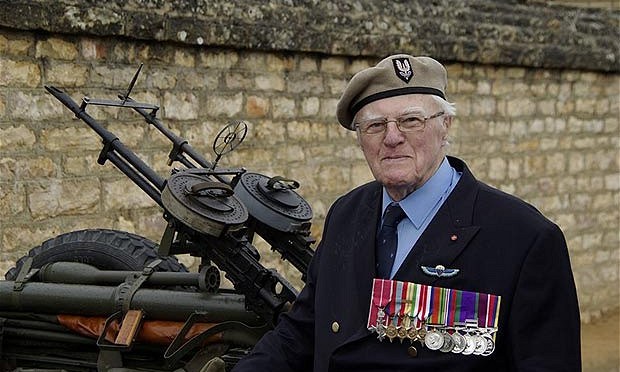
One of the last great warriors of his generation, Major Joe Schofield, MBE who joined the SAS in 1941 and finally retired in 1979 has died at the age of 90.

Joe was one of the originals who served alongside David Stirling and Paddy Mayne in North Africa, operating behind the German lines to gain intelligence, destroy enemy aircraft and attack their supply and reinforcement routes.  He was still serving 32 years after the end of Word War Two when SAS ‘observers’ joined members of the West German counter-terrorism group GSG9 to storm Lufthansa Flight 181 in Mogadishu, rescuing all 86 passengers on board.

I wonder what Joe made of this collaboration with former adversaries? Although, in retirement, he was tireless in organising visits to France to lay wreaths on the graves of those members of the SAS who had been killed (and, in some instances, executed), I’m sure he recognised it as a sign of progress.

Rest in Peace, Joe.

SPIN ZHIRA: Old Man in Helmand is the unauthorised, unvarnished and irreverent story of one man’s midlife crisis on the front line of the most dangerous district in Afghanistan where the locals haven’t forgiven the British for the occupation of 1842 or for the Russian Invasion of 1979. Of course, all infidels look the same so you can’t really tell them apart.
 

The secret life of an army officer

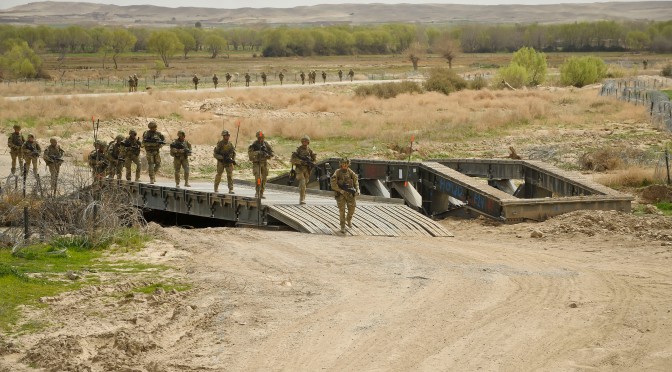
Writing anonymously in The Guardian an officer reveals what life is really like in today’s army where ‘recent redundancies have left many people doing upwards of three jobs to cover the workload.’

SPIN ZHIRA: Old Man in Helmand is the unauthorised, unvarnished and irreverent story of one man’s midlife crisis on the front line of the most dangerous district in Afghanistan where the locals haven’t forgiven the British for the occupation of 1842 or for the Russian Invasion of 1979. Of course, all infidels look the same so you can’t really tell them apart.
 

Did the UK leave Helmand too soon?

Two years after British Forces pulled out of Camp Bastion, Jonathan Beale, the BBC’s Defence Correspondent asks: Did the UK leave Afghanistan’s Helmand too soon?

The answer is yes and no.

‘No’ in the sense that one definition of madness is to keep on doing the same thing over and over again and expecting something different to happen. US and UK counter-insurgency doctrine is childishly optimistic and doesn’t work. Two failed counter-insurgency interventions in Iraq and Afghanistan are clear evidence of this, but the doctrine still stubbornly persists. Staying in Helmand  on these terms would have done nothing more than prolong the agony.

‘Yes’ in the sense that, with the right doctrine, more could have and should have been done. But it requires a shift in mindset as well as doctrine. Current political and military thinking is based on minimums. The minimum number of troops committed for the minimum amount of time. The best logic for staying in Helmand is to honour the sacrifice of the fallen, so that they did not die in vain. This is not a winning formula.

If we are to return to Helmand it must be with a new counter-insurgency doctrine, a clear understanding of the desired outcome and a realistic time-frame measured in decades rather than years.

SPIN ZHIRA: Old Man in Helmand is the unauthorised, unvarnished and irreverent story of one man’s midlife crisis on the front line of the most dangerous district in Afghanistan where the locals haven’t forgiven the British for the occupation of 1842 or for the Russian Invasion of 1979. Of course, all infidels look the same so you can’t really tell them apart.
Purchase your copy of SPIN ZHIRA

Incompetence and Arrogance at the MOD

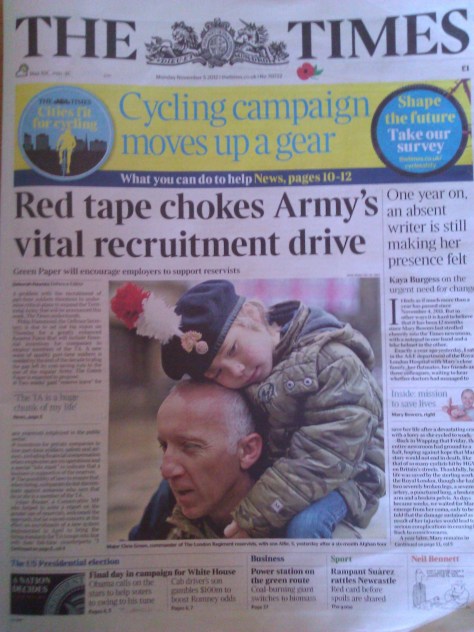
The Times, 05 November 2012
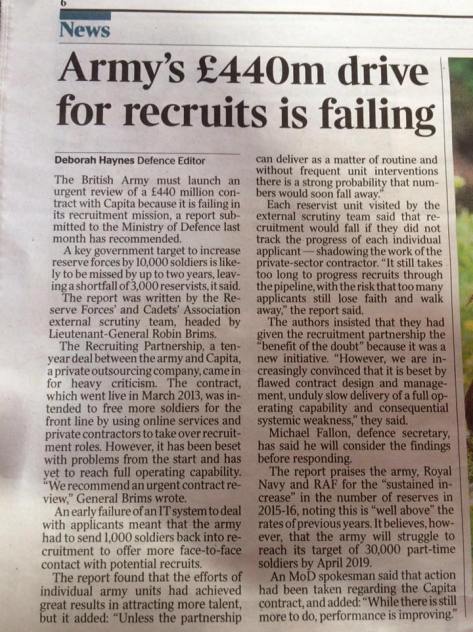
Alfie and I make the front page of The Times today. Apparently Alfie’s application for enlistment into the Reserves has been delayed by red tape.

In November 2012, Deborah Haynes, The Times Defence Editor used a photo of Alfie and me to illustrate an article she had written exposing failings in Army Recruiting. Four years later and she is still writing about it.

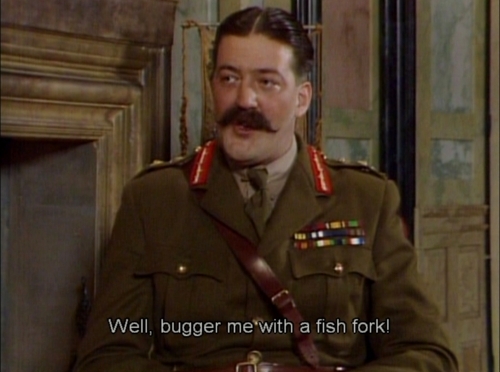
It is yet another example of the extent of the incompetence and arrogance at the MoD. Despite obvious failings, little has been done to address the issue. As General Melchett once said, ‘If nothing else works a total pig-headed unwillingness to look facts in the face will see us through’.

The impact is considerable. It creates significant gaps in our defence capability, leaving the army undermanned and the nation vulnerable. The knock-on effect is to increase the demands on our serving soldiers who are required to do more with less to fill these capability gaps which, in turn damages morale and well-being.

But perhaps the most depressing aspect of this astonishing mismanagement and waste is that it appears to have gone unchecked without any apparent accountability or culpability. Even now the MoD seems to be in denial, insisting ‘action has been taken’.

13718735_10153767027981334_6994360140441170744_n

SPIN ZHIRA: Old Man in Helmand is the unauthorised, unvarnished and irreverent story of one man’s midlife crisis on the front line of the most dangerous district in Afghanistan where the locals haven’t forgiven the British for the occupation of 1842 or for the Russian Invasion of 1979. Of course, all infidels look the same so you can’t really tell them apart.
Purchase your copy of SPIN ZHIRA

Children Bear Brunt of War

Reuters: Civilian Casualties increase as Afghan Troops Battle Taliban.

The United Nations Assistance Mission in Afghanistan (UNAMA) reports that 1,601 civilians were killed in the first half of the year with a further 3,565 wounded. These figures do not include the more than 80 killed in Saturday’s suicide attack in Kabul.

The report describes the figures as “alarming and shameful” and identifies that 24% of those killed were children.

In March 2015, in an interview with the BBC Tony Blair claimed “It’s important to understand that for all the challenges in Afghanistan there have been huge gains.” I wonder whether he still clings to that fallacy today?

RAF hero proved much more than a match for kidnappers

RAF Marham
The Sunday Express reports that the serviceman who fought off would-be kidnappers outside RAF Marham was part of an elite unit “whose training is more advanced than the standard infantry”.

It is, of course, a very serious incident and no-laughing matter but I’m still really looking forward to all the banter the Express newspaper’s reporting of the attack is going to generate.

‘I RETURNED TO the barracks to find a group of soldiers standing around their bergans, like so many girls at a school disco, quietly chatting and smoking, their cigarettes glowing in the dark as they patiently waited for the transport to RAF Brize Norton. A voice addressed me from the shadows:

‘Good of you to make it, Chris.’

It was the Adjutant, Captain Rupert Stevens. Rupert had been one of the first Grenadiers I’d met almost two years ago and although he’d always been supportive of my ambition to mobilise with the battalion, that didn’t mean he was averse to a bit of squaddie banter. He informed me that our trooping flight was scheduled for 07.00 the following morning but as this was ‘Crab Air’, army slang for the Royal Air Force, this was not a departure time but a no move before time. In his opinion it was anyone’s guess when we might eventually take off.

Rivalry and deep cultural differences between the armed services ensured that Rupert, like all self‑respecting soldiers, did not have a kind word to say about the RAF. Still there was some truth behind his comments. The RAF was trying to maintain a busy air bridge between the UK and Afghanistan using an ageing fleet of Lockheed Tristar aircraft. These had first come into service in 1978 as commercial airliners operated by Pan American Airways who subsequently sold them to the RAF shortly after the Falklands War.

After 34 years of service the Tristar was showing its age and, a bit like myself, was only just about fit for purpose.

Troops had become resigned to long delays in the journey to and from Afghanistan. It’s also fair to say that the RAF, unlike the aircraft’s original owner, is not a customer focussed organisation and puts little thought into the welfare of its passengers. We would all spend many hours experiencing RAF hospitality and it was never enjoyable. Disparaging comments not only helped to pass the time but also managed expectation.

Some months later a much publicised visit to Afghanistan by James Blunt and Catherine Jenkins was cancelled after the Tristar in which they were travelling was forced to abort and return to Cyprus, not once but twice, with first an air leak and then a problem with the undercarriage. James Blunt, himself a former soldier, was not impressed and wrote an uncomplimentary article in The Telegraph which delighted the rank and file but angered the top brass, who disputed his claims of military incompetence. For Rupert, who had been tasked with organising this visit and who had boasted for days about his self‑appointed role as Catherine Jenkins’ personal assistant, this would only serve to confirm his already very low opinion of the RAF.

Ironically, despite his obvious frustration, the RAF had actually done James a favour. So far as I could tell, Rupert had invested considerable time and effort preparing a detailed and comprehensive visit programme for Catherine in which he intended personally to take care of her every need and desire. By contrast he’d assumed ‘Blunty’ would doss down in the honking transit accommodation and sort himself out.’

SPIN ZHIRA: Old Man in Helmand is the unauthorised, unvarnished and irreverent story of one man’s midlife crisis on the front line of the most dangerous district in Afghanistan where the locals haven’t forgiven the British for the occupation of 1842 or for the Russian Invasion of 1979. Of course, all infidels look the same so you can’t really tell them apart.
Purchase your copy of SPIN ZHIRA


Seriously Idyllic

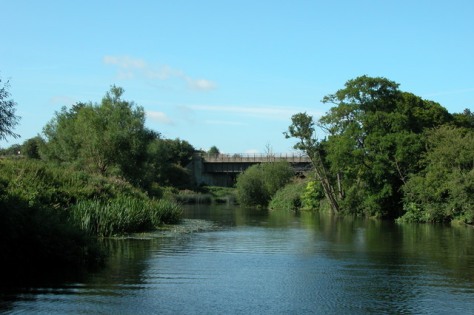
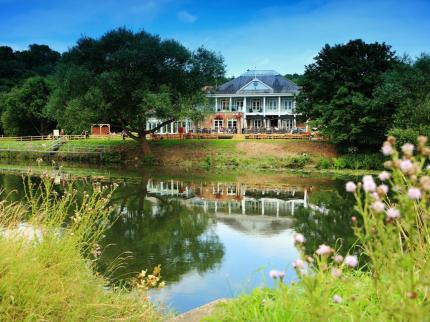
So yesterday was a seriously idyllic day in a quintessentially British way. A river cruise along the River Avon under azure summer skies followed by lunch with a mysterious English Rose in the gardens of the Bath Boathouse and a late afternoon swim with Sweep the dog at Avon Riverside.

River Avon Saltford


It’s the Britain I travelled 4,500 miles to protect:

‘I TRIED HARD, harder than usual, not to raise my voice as I ushered Harry and Alfie out the front door. It was Monday morning and I didn’t want to be late for school. More importantly, I didn’t want Harry and Alfie’s last memory of their father to be of ‘Grumpy Dad’. We went through the usual checklist:

Book bag. Check.

Pack-up. Check.

Shoes on the right feet. Check.

Coat. Check.

We were off, joining the procession of carefree children and their parents making their way down the lane.

Past the Post Office and the tennis courts.

Over the hump‑backed bridge, finishing line of the hotly contested annual village duck race.

Carefully looking left and right before crossing the road by the War Memorial.

Past the Black Bull pub, scene of Sunday afternoon coca‑colas.

Up the snicket, through the five‑bar gate and into the school playground.

I hoovered up every detail of the five minute journey, conscious that it might be the last few moments I would ever spend with my children. They would not see me again until I returned from Afghanistan and, although we didn’t discuss it, that might well be in a wooden casket or, worse still, unrecognisably shattered and broken.

No good for climbing trees.

No good for playing footie in the park using coats for goal-posts.

No good for games of off‑ground touch in the front room (don’t tell Mummy).

I didn’t want to think about it. I didn’t want them to think about it.

In the days leading up to this moment I’d carefully explained to them that I would be going away for nine months but I would return for R&R – rest and recuperation – in just three months. In time I hoped for Alfie’s birthday, although I couldn’t promise this. We discussed what we would get up to in the two weeks I’d be back; this mostly involved eating junk food and watching movies. Harry and Alfie quickly cottoned on that the usual parental controls would not apply. Every time the subject came up the checklist of stuff that wasn’t normally allowed grew longer.

It was an awkward wait for the bell that would signal the start of the school day. To everyone else in that playground it was a Monday morning just like any other. Children were excitedly catching up on the weekend’s news and activities. Parents chatted in little groups, glancing at their wrist watches as they waited for the teachers to take charge. It was a scene being played out, no doubt, right across the country but as an absentee father it was not one in which I belonged. I felt that all eyes were on the stranger in the midst of this tight‑knit village community.

I wanted to justify my absence more than my presence. They may or may not have thanked me for it but I was now keeping company with rough men standing ready to do violence in order to preserve this peaceful village idyll.’

SPIN ZHIRA: Old Man in Helmand is the unauthorised, unvarnished and irreverent story of one man’s midlife crisis on the front line of the most dangerous district in Afghanistan where the locals haven’t forgiven the British for the occupation of 1842 or for the Russian Invasion of 1979. Of course, all infidels look the same so you can’t really tell them apart.

Purchase your copy of SPIN ZHIRA


Boathouse Bath