Tag Archives: Afghanistan

Defence Chiefs accused of giving ISIS a ‘hit list’.

Following this morning’s news in The Times that the MoD, in its infinite wisdom, has published the details of every regular officer, reservist officer and university trainee on a government website, the Daily Mail have now picked up the story. My poor ex-father-in-law will be choking over his dinner:

‘I took out my patrol camera and started photographing anything I thought might be useful for the report I would be writing on my return. I’d got into the practice of doing this early on in the tour and had found it to be invaluable. Engrossed in this task I turned the corner of the compound and almost walked into Haji Jalander, the old Mujahideen I’d interviewed back in MOB Price. Somehow he’d slipped through the Danish cordon unnoticed.

Although I knew Haji was from Zumbalay it hadn’t occurred to me that I might meet him here. But my surprise was nothing compared to his. The last time we’d met I was pretty sure Haji was up for killing me. I certainly wouldn’t have been the first khareji he’d put to death, but once again I had the advantage on him. I was armed with more than just a camera, while he had only his trusty radiator key on its slender brass chain.

Finding my wits I wished him ‘As‑salaam Alaykoum’, to which he instinctively replied before he could check himself, ‘Alaykoum As‑salaam’. Pleasantries over we stood and stared at each other for a few moments before we were joined by one of the Tiger Team lads who spoke a little English.

I waited patiently while they spoke rapid‑fire Pashtu. It was clear the Tiger was getting the full backstory on how Haji and I came to be acquainted. Haji went on at length and the more he spoke the more the fierce old Muj was winding himself up. I was reminded of my soon‑to‑be‑ex father‑in‑law who had a similar capacity to raise his own blood pressure to dangerous levels simply by reading The Daily Mail.

Eventually Haji ran out of steam and the Tiger turned to me and skilfully translated his lengthy diatribe into four words: ‘You know this man?’

I acknowledged that I did and asked him to enquire after Haji’s son‑in‑law. Had he returned? This was obviously a mistake as it set Haji off on another long stream of uninterrupted invective.

The young Afghan soldier was clearly a master of the paraphrase. Laughing a little too nervously for my liking, he translated this last tirade:

‘He says you will die here today, the Taliban will not let you leave alive.’

SPIN ZHIRA: Old Man in Helmand is the unauthorised, unvarnished and irreverent story of one man’s midlife crisis on the front line of the most dangerous district in Afghanistan where the locals haven’t forgiven the British for the occupation of 1842 or for the Russian Invasion of 1979. Of course, all infidels look the same so you can’t really tell them apart.


ISIS GIVEN HITLIST

Deborah Haynes reveals in The Times today that the MoD, in its infinite wisdom, has published the details of every regular officer, reservist officer and university trainee on a government website.

I first met Deborah in Camp Bastion in 2012 when my unauthorised and unmonitored conversation with her caused the army media team who were handling her visit to get into a flap that I may have said something ‘off-message’.

When she called yesterday to ask me how I felt about the MoD’s public disclosure of my name, along with 20,000 others, I was a little taken aback. I assured her she must be mistaken. After the murder of Lee Rigby in 2013, servicemen have been repeatedly warned about the dangers of revealing their military service on social media and are cautioned against wearing their uniforms in public. Following this guidance and the very real risk of being targeted by Islamic terrorists, the MoD would never be so cavalier with our personal security.

I should have known better. This is, after all, the same ministry that continued to issue Lariam to troops long after the manufacturer had warned of the mental health risks associated with the drug. The same ministry that awarded Sir Bernard Grey a £45,000 bonus after he ran up an £23,000 expenses bill. And the same ministry that has paid £440 million in a failed recruitment drive.

Our names were published without our consent following a freedom of information request submitted, presumably, by Abu Bakr al-Baghdadi or one of his flunkies. Now that Deborah has exposed the blunder it’s comforting to know that the MoD has no plans to remove the list, insisting that ‘the security of our people is our foremost concern’.

SPIN ZHIRA: Old Man in Helmand is the unauthorised, unvarnished and irreverent story of one man’s midlife crisis on the front line of the most dangerous district in Afghanistan where the locals haven’t forgiven the British for the occupation of 1842 or for the Russian Invasion of 1979. Of course, all infidels look the same so you can’t really tell them apart.
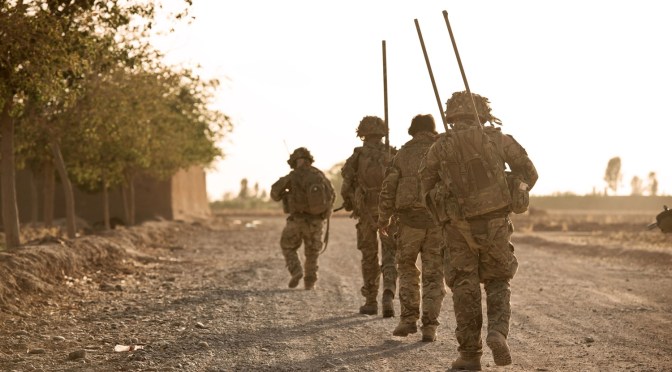
The Pentagon has lost hundreds of thousands of firearms.

As the 2016 UN Arms Trade Treaty (ATT) conference winds down in Geneva this week, the New York Times reports that the Pentagon has lost track of hundreds of thousands of firearms it distributed in Iraq and Afghanistan many of which now fuel an almost bottomless arms black market across the Middle East, adding to the violence and instability which plagues the region.

The ATT, of which the United States is a signatory, is a ‘multilateral, legally-binding agreement that establishes common standards for the international trade of conventional weapons and seeks to reduce the illicit arms trade. The treaty aims to reduce human suffering caused by illegal and irresponsible arms transfers, improve regional security and stability, as well as to promote accountability and transparency by state parties concerning transfers of conventional arms.’  In other words, exactly what the US has failed to do in Iraq and Afghanistan.

In all, the Pentagon provided more than 1.45 million firearms to various security forces in both countries, including more than 978,000 assault rifles, 266,000 pistols and almost 112,000 machine guns. It can now account for less than 50% of them. According to a Pentagon spokesman, ‘speed was essential in getting those nations’ security forces armed, equipped and trained…as a result, lapses in accountability of some of the weapons transferred occurred.’

I’m not at all surprised. Every so often I would patrol with US Special Forces in Helmand and on one of these occasions my US Navy Seal hosts took with them a battered old wheelbarrow piled high with AK47s. These were handed out to locals together with a baseball cap and a little cloth badge declaring the wearer was now a member of the Afghan Local Police (ALP). I don’t recall seeing any paperwork for this particular transfer and I got the distinct impression it was not the first wheelbarrow of assault weapons the Seals had handed out.

SPIN ZHIRA: Old Man in Helmand is the unauthorised, unvarnished and irreverent story of one man’s midlife crisis on the front line of the most dangerous district in Afghanistan where the locals haven’t forgiven the British for the occupation of 1842 or for the Russian Invasion of 1979. Of course, all infidels look the same so you can’t really tell them apart.

5,313 IED events in Helmand.

According to Forces TV, the MoD has released a one-off report detailing the injuries suffered by UK troops during Operation Herrick in Helmand. Improvised explosive devices (IEDs) accounted for 5,313 ‘events’ resulting in traumatic injury to 1, 982 British service personnel.

By the time I arrived in Afghanistan in January 2012 the IED was the Taliban weapon of choice. In nine months the combined Afghan, Danish and British force with whom I worked suffered 117 IED strikes and discovered a further 241 IEDs:

‘As the Grenadiers or fighting Ribs of Inkerman Company knew only too well, living with the constant possibility that your every next step may trigger an IED slowly and inevitably degrades the human spirit. It pervades every waking moment and is a constant and exhausting factor. Every breath must be carefully savoured lest it be your last. Every footfall must be critically considered and evaluated before being placed. Each tread is committed with unyielding trepidation. The euphoria of one safe step is immediately replaced by apprehension at the next and so on and so on until …

According to Aristotle, “Fear is pain arising from the anticipation of evil.” Not being as erudite as the great Greek polymath, for me, fear is the ever‑present possibility that my fellow man has carefully concealed a yellow palm oil container packed with a volatile mixture of ammonium nitrate and aluminium in the ground beneath my feet. It is the screaming anticipation that my very next step will initiate this crude mixture and a dark and powerful blast will remove my legs and my manhood and leave me bloodied and broken in the dirt.

As friends and colleagues fall victim to these devices and are forever mutilated or killed in circumstances or locations you have visited yourself, it becomes possible to reflect not that you have been lucky, but that you must be next. It’s a conviction that slowly and inexorably takes hold in the darkest recesses of your exhausted mind and grows like a malignant cancer.

During the course of my patrols in the Gap I witnessed young Guardsmen so overcome with fear that they would vomit at the front gates of the base before bravely stepping off on a patrol they have convinced themselves will be their last. I have also seen men so exhausted by constant vigilance that they lose all reason and stumble about blindly, no longer caring if they live or die.

Both are equally distressing to observe. But in this I was not always a mere observer.

On one patrol I was myself so overwhelmed by the certainty that I was about to take my last few steps on this earth that I became rooted to the spot unable to move either forward or back. It took the gentle and patient persuasion of a better man half my age to guide me, temporarily broken and useless, to safety.

I would hear IEDs detonated by other callsigns, sometimes less than a kilometre distant. Or I would join a platoon for a few days, to learn soon afterwards that one of their number had been grievously wounded.

One device claimed the legs of another London Regiment soldier, Lance Corporal John Wilson with whom I’d trained and prepared for deployment, another took the foot of Jay, an SF soldier whom I’d got to know. Jay had postponed his end of tour date when yet more faults on the ageing RAF Tristar fleet had delayed his replacement’s arrival into theatre.

I tried to convince him that he didn’t need to go back out on the ground but he ignored my advice. When the news came through that his patrol had been whacked by an IED and had a serious casualty I instantly feared it must be him, and so it proved to be. Some reckoned he’d been lucky – the device only partially detonated and his injuries could have been much worse – but I knew that Jay’s luck had run out with his chuff chart.’

SPIN ZHIRA: Old Man in Helmand is the unauthorised, unvarnished and irreverent story of one man’s midlife crisis on the front line of the most dangerous district in Afghanistan where the locals haven’t forgiven the British for the occupation of 1842 or for the Russian Invasion of 1979. Of course, all infidels look the same so you can’t really tell them apart.

Spare a thought for Kabul students

As students in the United Kingdom wake up to their GCSE grades this morning spare a thought for their counterparts at Kabul’s American University who have been caught up in an overnight gun-battle between insurgents and the security forces.

Following a suicide car bombing at the university’s entrance, Canada’s CBC News reports that at least 12 have been killed and dozens wounded as the gun battle raged around the sprawling campus.

SPIN ZHIRA: Old Man in Helmand is the unauthorised, unvarnished and irreverent story of one man’s midlife crisis on the front line of the most dangerous district in Afghanistan where the locals haven’t forgiven the British for the occupation of 1842 or for the Russian Invasion of 1979. Of course, all infidels look the same so you can’t really tell them apart.
The secret life of an army officer

Writing anonymously in The Guardian an officer reveals what life is really like in today’s army where ‘recent redundancies have left many people doing upwards of three jobs to cover the workload.’

SPIN ZHIRA: Old Man in Helmand is the unauthorised, unvarnished and irreverent story of one man’s midlife crisis on the front line of the most dangerous district in Afghanistan where the locals haven’t forgiven the British for the occupation of 1842 or for the Russian Invasion of 1979. Of course, all infidels look the same so you can’t really tell them apart.

 

#22 Kill #22 Pushups

Everyone is joining in the 22 pushup challenge to raise awareness of PTSD amongst veterans, 22 being the number of American service veterans who commit suicide each day. As with all things viral it has its detractors and there is some scepticism about the accuracy of the statistics involved.

In the United Kingdom the Ministry of Defence maintains that mental health problems amongst its servicemen are in line with the general population – but the MoD does not have a particularly good track record for honesty when it comes to bad news.

Given the extensive and prolonged use of Lariam as the MoD’s anti-malarial of choice, long after the manufacturer identified it may induce potentially serious neuropsychiatric disorders, I’m personally inclined to disbelieve them.

Recent studies in the USA indicate that Lariam amplifies the effects of PTSD and some experts have suggested that the British Army now faces a mental health catastrophe.

Whatever the rights or wrongs of the statistics, servicemen suffering from PTSD deserve our support.

22 pushups is not a lot to ask.

Press up challenge

SPIN ZHIRA: Old Man in Helmand is the unauthorised, unvarnished and irreverent story of one man’s midlife crisis on the front line of the most dangerous district in Afghanistan where the locals haven’t forgiven the British for the occupation of 1842 or for the Russian Invasion of 1979. Of course, all infidels look the same so you can’t really tell them apart.


Innocence Lost

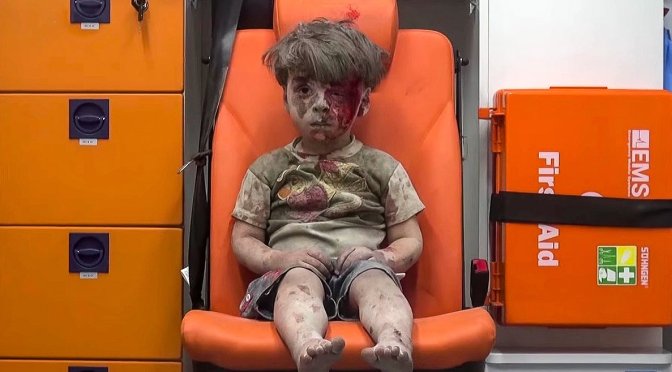
The moving image of a five year old Syrian boy, Omran Daqneesh, sitting bloodied and dazed in the back of an ambulance has been widely circulated on social media. It highlights the desperate plight of the citizens of Aleppo, caught in the crossfire of an increasingly violent and vicious civil war.

The image has been compared with that of Syrian toddler, Aylan Kurdi, washed up on a Bodrum beach and has renewed calls for the West to do something to stop the bloodshed. But the question is what?

Migrant boat accident in Turkey

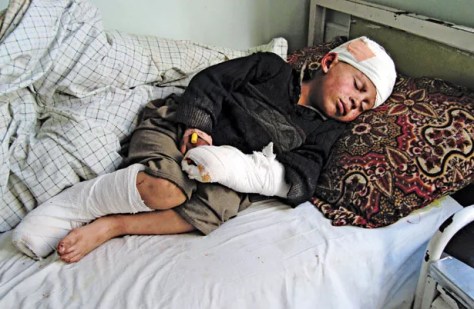
Images of children wounded in NATO airstrikes resulted in widespread condemnation for the interventions in Iraq and Afghanistan, both of which have proved disastrous for the citizens of those countries.

Injured Afghan boy

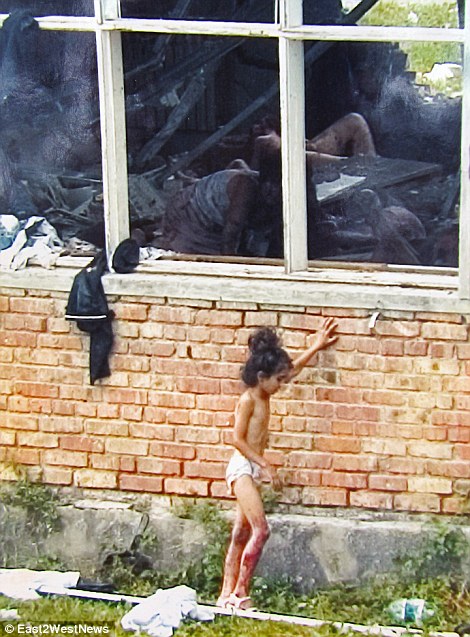
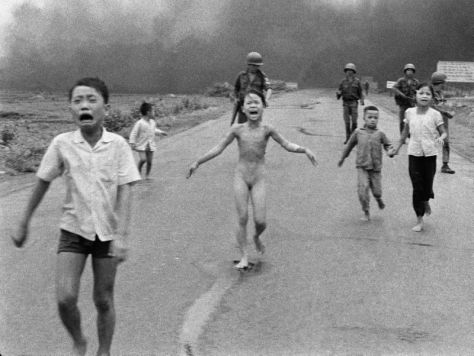
Painful images of innocence painfully lost have communicated the horrors of war in a way that words could never describe since Vietnam. Despite having witnessed lost innocence firsthand in the Balkans in the 1990s, I was still moved to tears in 2004 by the image of a bloodied Aida Sidakova climbing through the window of her school gymnasium in search of her mum following the Beslan school bombing by Islamist terrorists.

Beslan School Massacre

Our reaction to these images is instinctive and transcends religious or cultural divides but sadly does not endure. Tomorrow, or the next day, we will return to our lives of comfortable consumerism and forget about the difficult question of what to do in Aleppo – at least until the next image of innocence lost pricks our conscience.

Vietnam napalm girl

Did the UK leave Helmand too soon?

Two years after British Forces pulled out of Camp Bastion, Jonathan Beale, the BBC’s Defence Correspondent asks: Did the UK leave Afghanistan’s Helmand too soon?

The answer is yes and no.

‘No’ in the sense that one definition of madness is to keep on doing the same thing over and over again and expecting something different to happen. US and UK counter-insurgency doctrine is childishly optimistic and doesn’t work. Two failed counter-insurgency interventions in Iraq and Afghanistan are clear evidence of this, but the doctrine still stubbornly persists. Staying in Helmand  on these terms would have done nothing more than prolong the agony.

‘Yes’ in the sense that, with the right doctrine, more could have and should have been done. But it requires a shift in mindset as well as doctrine. Current political and military thinking is based on minimums. The minimum number of troops committed for the minimum amount of time. The best logic for staying in Helmand is to honour the sacrifice of the fallen, so that they did not die in vain. This is not a winning formula.

If we are to return to Helmand it must be with a new counter-insurgency doctrine, a clear understanding of the desired outcome and a realistic time-frame measured in decades rather than years.

SPIN ZHIRA: Old Man in Helmand is the unauthorised, unvarnished and irreverent story of one man’s midlife crisis on the front line of the most dangerous district in Afghanistan where the locals haven’t forgiven the British for the occupation of 1842 or for the Russian Invasion of 1979. Of course, all infidels look the same so you can’t really tell them apart.

Purchase your copy of SPIN ZHIRA

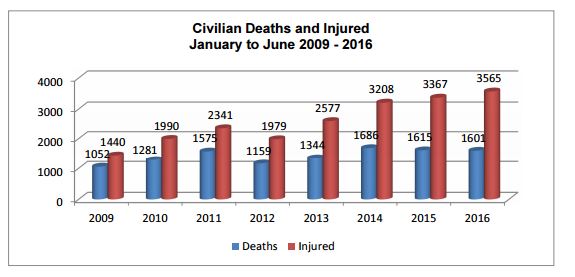
In a new low for the Afghan conflict, UN figures reveal civilian casualties reach record high.

Linear Regression

In July 2012, using data unwittingly supplied by Regional Command South West (RCSW), I forecast that public perception of the Afghan Government would fall below that of the Taliban. My report was deemed “off-message” and suppressed. General Gurganus, the US Marine Corps General who commanded RCSW insisted ‘We are winning and the Taliban are losing.’

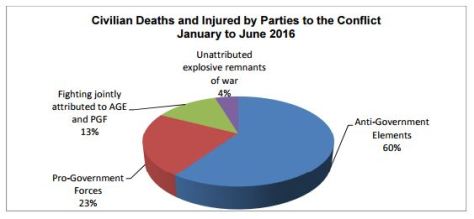
Yesterday’s report from the United Nations Assistance Mission in Afghanistan (UNAMA) sadly confirms my analysis. Not only have civilian casualties reached record levels, not only has the Afghan government largely abandoned the population it is mandated to protect but its own troops are responsible for 23% of those casualties.

UNAMA report 1

“Every single casualty documented in this report, every woman, girl, or boy denied access to education or adequate healthcare and every man or woman deprived of their livelihood, represents a failure of commitment and should be a call to action for parties to the conflict to take meaningful, concrete steps to reduce civilian suffering and increase protection. Platitudes not backed by meaningful action ring hollow over time. History and the long memory of the Afghan people will judge leaders of all parties to this conflict not by their well-meaning words, but by their conduct.” Tadamichi Yamamoto, United Nations Special Representative of the Secretary-General in Afghanistan, Kabul July 2016