A picture paints a thousand words

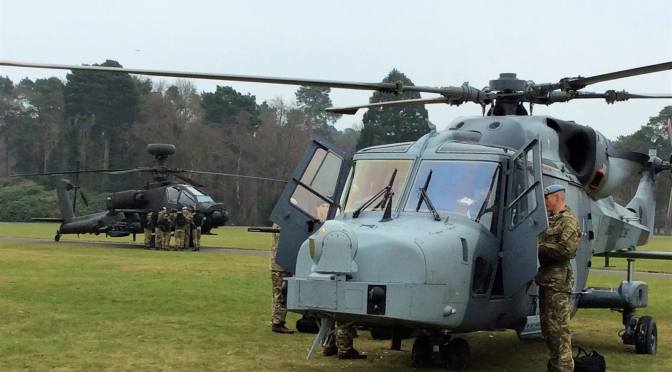
They say a picture paints a thousand words and this photo, courtesy of the Sandhurst Trust, is no exception. In the background on the left the awesome Apache attack helicopter, callsign Ugly. On the right in the foreground, the miserable Wildcat attack helicopter, callsign Crucial.

I was to discover that giving old bits of kit new names was a recurring theme. The ancient FV432 armoured personnel carrier, a relic of the 1960s Cold War, had returned to service as the ‘Bulldog’. The Lynx helicopter, somehow forced upon the British Army by Westland in a deal dating back to the 1970s, was now the ‘Wildcat’.

The Lynx was originally much loved by pilots for its ability to do a barrel roll. This feature made it tremendous fun to fly, but turned out not to be a battle winning capability and did little to compensate for its failings. It was too small to be an effective troop carrier, and lacked the integrated weapon systems of an attack helicopter. It had first come into service in the year Showaddywaddy topped the charts with ‘You got what it takes’ but as a military helicopter it could never aspire to the title of that particular hit single.

A Lynx would later get me out of trouble whilst on a fighting patrol in the insurgent stronghold of Zumbalay. Following a pre‑dawn infiltration to probe enemy strengths and dispositions our presence had proved unpopular with the local Taliban. A number of small arms engagements ensued before the insurgents succeeded in blocking our exfiltration route. It was time to call for some air support and an Apache attack helicopter, callsign Ugly, was requested.

The Ugly is an awesome killing machine and the Taliban know better than to try and take it on. Its presence alone would be enough to make them go to ground and secure our safe passage. But we were informed that our request would be met by a different attack helicopter, callsign Crucial. This callsign was unknown to me and, when it came on station a few minutes later, I was dismayed to discover that it was nothing more than a Lynx with a 50‑calibre machine gun mounted in the door. Calling this an attack helicopter and thus comparing it with an Apache was like comparing the space shuttle with a paper aeroplane.

As I had anticipated, the Crucial did not have the desired effect on our adversaries, at least until the door gunner opened up with his 50, killing two of their number and giving us the opportunity to break cover and hot foot it back to the relative safety of our desert leaguer¹. I was grateful to the Lynx pilot and his crew, they may well have saved our lives, but I still reckoned the Lynx should have retired about the same time Showaddywaddy called it a day.

¹Leaguer (from South African Dutch Laager): A temporary defensive encampment surrounded by armoured vehicles – a military term originating from the Boer War.

SPIN ZHIRA: Old Man in Helmand is the unauthorised, unvarnished and irreverent story of one man’s midlife crisis on the front line of the most dangerous district in Afghanistan where the locals haven’t forgiven the British for the occupation of 1842 or for the Russian Invasion of 1979. Of course, all infidels look the same so you can’t really tell them apart.

‘The best book by a soldier concerning the Afghan War that I have read’
Frank Ledwidge, bestselling author of Losing Small Wars and Investment in Blood

‘SPIN ZHIRA vividly conveys the disjointed essence of modern warfare and the impossibility of balancing the adrenaline of combat with ‘normal’ life. This book brims with authenticity and dark humour.’
Patrick Hennessey, bestselling author of The Junior Officers’ Reading Club and Kandak

‘If you want to read about political and military success in Afghanistan, this book isn’t for you. If you want a fresh perspective from someone who is not a career officer and who is brave enough to bare his soul, then SPIN ZHIRA is a must read.’
Lt Col Richard Dorney, bestselling author of The Killing Zoneand An Active Service

‘Five stars’
SOLDIER The official magazine of the British Army

‘A journey of love, service and adventure. Excellent.’
Amazon Customer

Ten reasons why you should read SPIN ZHIRA.

British Army in Crisis

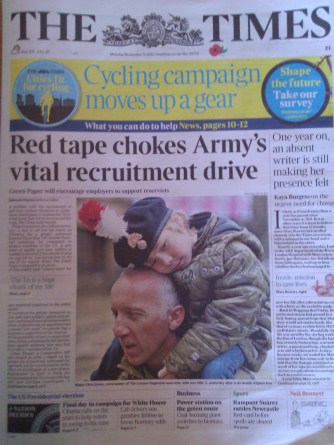
I see I made it into the Express this week, (front row, seventh from the left) helping to illustrate an article by Siobhan McFadyen about the army’s recruitment crisis. There seems to be a theme emerging. Last time my picture appeared in a National Newspaper it was under the headline: “Red Tape chokes Army’s vital recruitment drive.”

The Times, 05 November 2012

SPIN ZHIRA: Old Man in Helmand is the unauthorised, unvarnished and irreverent story of one man’s midlife crisis on the front line of the most dangerous district in Afghanistan where the locals haven’t forgiven the British for the occupation of 1842 or for the Russian Invasion of 1979. Of course, all infidels look the same so you can’t really tell them apart.

‘The best book by a soldier concerning the Afghan War that I have read’
Frank Ledwidge, bestselling author of Losing Small Wars and Investment in Blood

‘SPIN ZHIRA vividly conveys the disjointed essence of modern warfare and the impossibility of balancing the adrenaline of combat with ‘normal’ life. This book brims with authenticity and dark humour.’
Patrick Hennessey, bestselling author of The Junior Officers’ Reading Club and Kandak

‘If you want to read about political and military success in Afghanistan, this book isn’t for you. If you want a fresh perspective from someone who is not a career officer and who is brave enough to bare his soul, then SPIN ZHIRA is a must read.’
Lt Col Richard Dorney, bestselling author of The Killing Zoneand An Active Service

‘Five stars’
SOLDIER The official magazine of the British Army

‘A journey of love, service and adventure. Excellent.’
Amazon Customer
Ten reasons why you should read SPIN ZHIRA.

Guards face cold showers and no heating

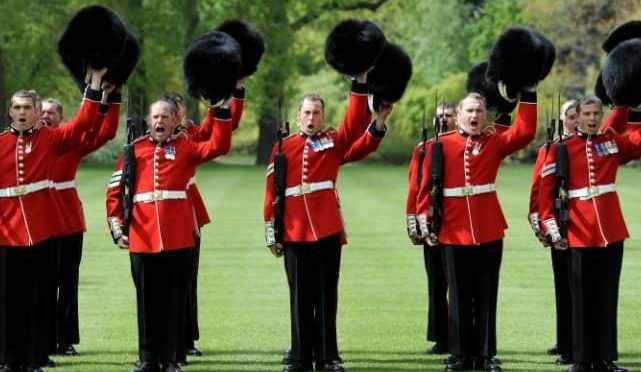
Henry Bodkin reports for The Telegraph that there is no hot water or central heating for the Guardsmen on duty at Buckingham Palace.

It’s all in a day’s work for the Queen’s guard and they routinely put up with much worse but it’s symptomatic of the state of disrepair and neglect that is undermining our Armed Forces.

I WAS WOKEN by the alarm on my smart phone which told me it was 6am. The touch screen briefly illuminated my surroundings before I reflexively stabbed the dismiss button and was once again plunged into darkness. I lay on my back, disoriented by sleep, momentarily uncertain of my surroundings. It was bitterly cold and as my eyes grew accustomed to the gloom I could see my breath condensing above me. I was tempted to roll over and go back to sleep when an enormous bald head came into view. The enormous head was attached to an enormous neck which in turn was attached to an enormous torso and two enormous, heavily tattooed arms. The head spoke, revealing enormous tombstone teeth:

“Sir, you snore like a fucking bastard. If it wasn’t so fucking cold last night I would’ve got up and fucking strangled you.”

I didn’t doubt him for a moment. The man mountain was Glenn Haughton, the Regimental Sergeant Major of the First Battalion Grenadier Guards. Glenn appeared part human part beast, caught in a perpetual semi‑transformative state between Dr Bruce Banner and The Incredible Hulk, at the point where his clothes no longer fit his outsize body but just before his skin turns green. I’d first met Glenn in Canada the year before and I knew he had a temper to match. Don’t make me angry. You wouldn’t like me when I’m angry. I was prepared to go to enormous lengths to avoid antagonising the big man and made a mental note to find alternative lodgings as soon as possible.

It was December 2011. I had driven up from London in freezing fog the night before to the Stanford Training Area in Thetford to join the Grenadiers for the last phase of their collective training. This would be the final OPTAG assessment before the headquarters team, of which I was a part, would deploy to Afghanistan in January 2012. It would also be my first opportunity to meet the new Commanding Officer, Lieutenant Colonel James Maurice Hannan Bowder, MBE.


It was gone midnight when I reported to the guardroom at Wretham Camp. From there I was driven to Smokers Hole FOB, a purpose built Forward Operating Base on the training area which housed the battalion operations room and would be my home for the next few days. I was shown to a large tent, already occupied by a dozen or so somnolent figures, and invited to make myself comfortable. Inside the tent it was well below freezing and pitch black. With encouragement from some of the anonymous figures in the dark to shut the fuck up, I did my best to silently extract my sleeping bag from my bergan and find a space to get my head down.

After my encounter with the Sarn’t Major the following morning, sleep was beyond me and so I quickly pulled on my combat trousers and Helly Hanson fleece top in an attempt to conserve body heat. As I fumbled with the laces of my boots with fingers numbed by cold I noted that since my last outing with them the Grenadiers had been issued the new multi‑terrain pattern (MTP) uniforms which were now being worn in Afghanistan. I would not be issued with the new clothing, which was a much lighter shade of green than my own, for another couple of weeks. In the meantime I was going to stand out like a sore thumb, further highlighting my reserve status amongst these full‑time soldiers.

Wash and shave kit in hand I went in search of the Puffing Billy, otherwise known as the M67 Army Liquid Fuel Immersion Heater. This is a genius piece of kit, originally of US design, dating back to 1943. Nicknamed the ‘Kitchen Mortar’ by US troops it consists of an old metal dustbin filled with water to which is clamped a diesel fired drip fed immersion heater with an enormous chimney. The Puffing Billy can produce a good quantity of hot water suitable for washing and shaving purposes, albeit with a greasy slick of diesel on the surface, but it takes a brave man to light one.

The preferred method being to throw a lighted match down the chimney and run like hell.

Sadly there was to be no hot water that morning. Not because there was no man brave enough to throw the match amongst these battle hardened soldiers but because it was so cold the diesel had started to wax and would not flow. I resigned myself to a cold shave and wandered over to a bowser where a man was breaking the ice on its surface to get to the water below. We both collected a bowl of frigid water and shared a wooden trestle table to wash and shave in silence. The ground on which we stood was still white with frost but this did not deter my companion from stripping to the waist to complete his ablutions. I felt no desire to follow his example. Keeping my Helly Hanson zipped to the neck, my own administrations were far less thorough. It was only when the stranger beside me pulled on his shirt that I noticed the distinctive Crown and Bath Star rank slide that denoted his status as the Commanding Officer.

It was my new boss.

SPIN ZHIRA: Old Man in Helmand is the unauthorised, unvarnished and irreverent story of one man’s midlife crisis on the front line of the most dangerous district in Afghanistan where the locals haven’t forgiven the British for the occupation of 1842 or for the Russian Invasion of 1979. Of course, all infidels look the same so you can’t really tell them apart.

‘The best book by a soldier concerning the Afghan War that I have read’
Frank Ledwidge, bestselling author of Losing Small Wars and Investment in Blood

‘SPIN ZHIRA vividly conveys the disjointed essence of modern warfare and the impossibility of balancing the adrenaline of combat with ‘normal’ life. This book brims with authenticity and dark humour.’
Patrick Hennessey, bestselling author of The Junior Officers’ Reading Club and Kandak

‘If you want to read about political and military success in Afghanistan, this book isn’t for you. If you want a fresh perspective from someone who is not a career officer and who is brave enough to bare his soul, then SPIN ZHIRA is a must read.’
Lt Col Richard Dorney, bestselling author of The Killing Zoneand An Active Service

‘Five stars’
SOLDIER The official magazine of the British Army

‘A journey of love, service and adventure. Excellent.’
Amazon Customer
Ten reasons why you should read SPIN ZHIRA.

Setting off to War

On this day five years ago I set off to war, speeding down the M4 motorway in the dead of night in an overloaded minibus.

5-4

I RETURNED TO the barracks to find a group of soldiers standing around their bergans, like so many girls at a school disco, quietly chatting and smoking, their cigarettes glowing in the dark as they patiently waited for the transport to RAF Brize Norton. A voice addressed me from the shadows:

“Good of you to make it, Chris.”

It was the Adjutant, Captain Rupert Stevens. Rupert had been one of the first Grenadiers I’d met almost two years ago and although he’d always been supportive of my ambition to mobilise with the battalion, that didn’t mean he was averse to a bit of squaddie banter. He informed me that our trooping flight was scheduled for 07.00 the following morning but as this was ‘Crab Air’, army slang for the Royal Air Force, this was not a departure time but a no move before time. In his opinion it was anyone’s guess when we might eventually take off.

Rivalry and deep cultural differences between the armed services ensured that Rupert, like all self‑respecting soldiers, did not have a kind word to say about the RAF. Still there was some truth behind his comments. The RAF was trying to maintain a busy air bridge between the UK and Afghanistan using an ageing fleet of Lockheed TriStar aircraft. These had first come into service in 1978 as commercial airliners operated by Pan American Airways who subsequently sold them to the RAF shortly after the Falklands War.

After 34 years of service the TriStar was showing its age and, a bit like myself, was only just about fit for purpose.

Troops had become resigned to long delays in the journey to and from Afghanistan. It’s also fair to say that the RAF, unlike the aircraft’s original owner, is not a customer focussed organisation and puts little thought into the welfare of its passengers. We would all spend many hours experiencing RAF hospitality and it was never enjoyable. Disparaging comments not only helped to pass the time but also managed expectation.

Some months later a much publicised visit to Afghanistan by James Blunt and Catherine Jenkins was cancelled after the TriStar in which they were travelling was forced to abort and return to Cyprus, not once but twice, with first an air leak and then a problem with the undercarriage. James Blunt, himself a former soldier, was not impressed and wrote an uncomplimentary article in The Telegraph which delighted the rank and file but angered the top brass, who disputed his claims of military incompetence. For Rupert, who had been tasked with organising this visit and who had boasted for days about his self‑appointed role as Catherine Jenkins’ personal assistant, this would only serve to confirm his already very low opinion of the RAF.

Ironically, despite his obvious frustration, the RAF had actually done James a favour. So far as I could tell, Rupert had invested considerable time and effort preparing a detailed and comprehensive visit programme for Catherine in which he intended personally to take care of her every need and desire. By contrast he’d assumed ‘Blunty’ would doss down in the honking transit accommodation and sort himself out.

01.00 came and went with no sign of the coaches. No one seemed to mind terribly much and we continued chatting in our little groups as the grass turned white with frost around us. It was bitterly cold but since none of my colleagues, not even Tom, seemed to have noticed, I wasn’t about to bring it up. Nor did they seem to share my own sense of foreboding. The group appeared relaxed, almost carefree. It would have been hard to tell that these men, only a few hours previously, had said goodbye to their families and were setting off to a war with which they were already familiar and which had claimed the lives of friends and colleagues.

Some, like Captain Paddy Rice, even bore the scars of previous deployments. Paddy, described by The Telegraph in 2009 as ‘the luckiest soldier in Afghanistan’, had narrowly escaped death when he was targeted by a Taliban sniper. The bullet had entered just below his left shoulder blade, travelled across his back and exited by his right ear. Paddy had calmly lit a cigarette before radioing in his own nine liner¹ requesting immediate medical evacuation to Camp Bastion.

A gunshot wound is an almost guaranteed ticket home and a lesser man might have chosen to convalesce in the UK but Paddy was back on duty just three weeks later. With nothing to do all day but sit around smoking, Paddy reckoned Camp Bastion hospital had been bad for his health. So he’d volunteered to return to his unit as soon as possible.

Eventually someone went in search of some news and a short while later an ancient Ford Fiesta screeched up. It was Dave Kenny, our Chief of Staff, who would not be deploying for another few months. He jumped out, talking urgently into a mobile phone. Looking thoroughly harassed, he explained that there’d been a SNAFU² and the coach was booked for the following day. It was now close to 2am and he was trying to organise some alternative transport. Not unreasonably, everyone who might be able to assist him was tucked up asleep in bed.

He jumped back into the Fiesta, phone still clamped to his ear and roared away, wheels spinning, to return half an hour later with a couple of minibuses and two bleary-eyed drivers. Somehow, with Dave clucking about us like a mother hen, we managed to load all our gear and ourselves into these vehicles. Packed like sardines, we set off at breakneck speed.

Barrelling down the motorway in an overloaded minibus in the dead of night was not quite how I’d imagined myself setting off to war.

¹Nine Liner: Medical evacuation request, so called because of the nine point reporting format
²SNAFU: situation normal, all fucked up

SPIN ZHIRA: Old Man in Helmand is the unauthorised, unvarnished and irreverent story of one man’s midlife crisis on the front line of the most dangerous district in Afghanistan where the locals haven’t forgiven the British for the occupation of 1842 or for the Russian Invasion of 1979. Of course, all infidels look the same so you can’t really tell them apart.

‘The best book by a soldier concerning the Afghan War that I have read’
Frank Ledwidge, bestselling author of Losing Small Wars and Investment in Blood

‘SPIN ZHIRA vividly conveys the disjointed essence of modern warfare and the impossibility of balancing the adrenaline of combat with ‘normal’ life. This book brims with authenticity and dark humour.’
Patrick Hennessey, bestselling author of The Junior Officers’ Reading Club and Kandak

‘If you want to read about political and military success in Afghanistan, this book isn’t for you. If you want a fresh perspective from someone who is not a career officer and who is brave enough to bare his soul, then SPIN ZHIRA is a must read.’
Lt Col Richard Dorney, bestselling author of The Killing Zoneand An Active Service

‘Five stars’
SOLDIER The official magazine of the British Army

‘A journey of love, service and adventure. Excellent.’
Amazon Customer

Ten reasons why you should read SPIN ZHIRA.

Britain has never been more ready for conflict

On this day 26 years ago, the shooting started in Gulf War One.

As military tradition dictates, the British Army was ill-prepared. Insufficient desert combat uniforms and body armour to equip the entire force; a shoddily manufactured and woefully unreliable personal weapon system in the SA80 Mark 1 and no doctrine or training in desert warfare. I know, I was there.

In the intervening 26 years, despite the conflicts in Iraq and Afghanistan, things have got worse rather than better for the British Army. While personal issue equipment and clothing has improved substantially, there are now 60,000 fewer soldiers than there were in 1991. Training budgets have also been slashed meaning those that are left are less well trained.  And, thanks to increased demands coupled with diminished terms and conditions of service, morale is at rock bottom.

Based on the long-standing British military tradition of running down its armed forces prior to committing them to battle, we have never been more ready for conflict. Which is just as well given the multiple threats we face today.

SPIN ZHIRA: Old Man in Helmand is the unauthorised, unvarnished and irreverent story of one man’s midlife crisis on the front line of the most dangerous district in Afghanistan where the locals haven’t forgiven the British for the occupation of 1842 or for the Russian Invasion of 1979. Of course, all infidels look the same so you can’t really tell them apart.

‘The best book by a soldier concerning the Afghan War that I have read’
Frank Ledwidge, bestselling author of Losing Small Wars and Investment in Blood

‘SPIN ZHIRA vividly conveys the disjointed essence of modern warfare and the impossibility of balancing the adrenaline of combat with ‘normal’ life. This book brims with authenticity and dark humour.’
Patrick Hennessey, bestselling author of The Junior Officers’ Reading Club and Kandak

‘If you want to read about political and military success in Afghanistan, this book isn’t for you. If you want a fresh perspective from someone who is not a career officer and who is brave enough to bare his soul, then SPIN ZHIRA is a must read.’
Lt Col Richard Dorney, bestselling author of The Killing Zoneand An Active Service

‘Five stars’
SOLDIER The official magazine of the British Army

‘A journey of love, service and adventure. Excellent.’
Amazon Customer

Ten reasons why you should read SPIN ZHIRA.


Why is the Sergeant leaving?

15873418_1786732548243222_2381775695069947313_n

The British Army continues to laugh in the face adversity, but how on earth did it get to this point?

The Army’s senior commanders have failed to understand that loyalty, a central tenet of the Army’s Values and Standards, must first flow down the chain of command before it can be reflected back up.

In placing career before duty, commanders have not only been disloyal to the men and women under their command but have also undermined the principles of selfless commitment, respect, integrity and moral courage.

The very principles on which the British Army is founded.

SPIN ZHIRA: Old Man in Helmand is the unauthorised, unvarnished and irreverent story of one man’s midlife crisis on the front line of the most dangerous district in Afghanistan where the locals haven’t forgiven the British for the occupation of 1842 or for the Russian Invasion of 1979. Of course, all infidels look the same so you can’t really tell them apart.

‘The best book by a soldier concerning the Afghan War that I have read’
Frank Ledwidge, bestselling author of Losing Small Wars and Investment in Blood

‘SPIN ZHIRA vividly conveys the disjointed essence of modern warfare and the impossibility of balancing the adrenaline of combat with ‘normal’ life. This book brims with authenticity and dark humour.’
Patrick Hennessey, bestselling author of The Junior Officers’ Reading Club and Kandak

‘If you want to read about political and military success in Afghanistan, this book isn’t for you. If you want a fresh perspective from someone who is not a career officer and who is brave enough to bare his soul, then SPIN ZHIRA is a must read.’
Lt Col Richard Dorney, bestselling author of The Killing Zoneand An Active Service

‘Five stars’
SOLDIER The official magazine of the British Army

‘A journey of love, service and adventure. Excellent.’
Amazon Customer

Ten reasons why you should read SPIN ZHIRA.

I’m dreading the next snowfall

There has been no fresh snowfall in the Trois Vallees for over six weeks. Christmas and New Year passed by with not even a single, solitary flake.

Like everyone else I’ve been silently praying for snow and finally, it seems our prayers are to be answered. Snow is already falling in Verbier, Switzerland and Meteo France predicts significant snowfalls for the Trois Vallees in the coming days.

But now the snow is finally coming there’s a part of me that dreads its arrival – because I know it will be deadly. In the excitement of fresh powder caution will be thrown to the winds. Skiers will duck under the rope and venture  onto virgin snowfields without the correct equipment and without understanding or analysing the risks involved. I know this because, sadly,  it happens on every powder day. Last season I was in close proximity to two fatal avalanches triggered by the skiers who lost their lives. The year before I assisted in an unsuccessful avalanche rescue.

After such a long barren patch it seems horribly  inevitable that, in the next few days when the long awaited fresh snowfall finally arrives, tragedy will strike.

I will, of course, still be out on the mountain carving fresh tracks of my own, but this year my own elation will be tinged with a sadness that comes from the knowledge and experience of previous seasons.

SPIN ZHIRA: Old Man in Helmand is a unique account of the Afghan war as seen through the eyes of a middle-aged man thrust onto the frontline by a failed marriage, financial ruin and the words of John Stuart Mill (1806–1873). A true story of love, service and adventure, it is a compelling examination of choice that explores the landscape of war and commitment to cause and honour, juxtaposed against heartbreaking love for family and the persistent call of the untracked snowfield and its descent into the unknown.

‘The best book by a soldier concerning the Afghan War that I have read’
Frank Ledwidge, bestselling author of Losing Small Wars and Investment in Blood

‘SPIN ZHIRA vividly conveys the disjointed essence of modern warfare and the impossibility of balancing the adrenaline of combat with ‘normal’ life. This book brims with authenticity and dark humour.’
Patrick Hennessey, bestselling author of The Junior Officers’ Reading Club and Kandak

‘If you want to read about political and military success in Afghanistan, this book isn’t for you. If you want a fresh perspective from someone who is not a career officer and who is brave enough to bare his soul, then SPIN ZHIRA is a must read.’
Lt Col Richard Dorney, bestselling author of The Killing Zone and An Active Service

‘Five stars’
SOLDIER The official magazine of the British Army

‘A journey of love, service and adventure. Excellent.’
Amazon Customer

Ten reasons why you should read SPIN ZHIRA.

Phil Shiner: Greedy, unscrupulous w#nker.

Phil Shiner is one of the UK’s top human rights lawyers. He’s also a greedy, unscrupulous wanker. So it’s good to learn that he is to be struck off after admitting a string of misconduct charges. Johnny Mercer MP, will be pleased.

Let’s hope he is the first of many and that this marks the beginning of the end of the cynical gravy train that has hounded honourable British soldiers for years.

SPIN ZHIRA: Old Man in Helmand is the unauthorised, unvarnished and irreverent story of one man’s midlife crisis on the front line of the most dangerous district in Afghanistan where the locals haven’t forgiven the British for the occupation of 1842 or for the Russian Invasion of 1979. Of course, all infidels look the same so you can’t really tell them apart.

‘The best book by a soldier concerning the Afghan War that I have read’
Frank Ledwidge, bestselling author of Losing Small Wars and Investment in Blood

‘SPIN ZHIRA vividly conveys the disjointed essence of modern warfare and the impossibility of balancing the adrenaline of combat with ‘normal’ life. This book brims with authenticity and dark humour.’
Patrick Hennessey, bestselling author of The Junior Officers’ Reading Club and Kandak

‘If you want to read about political and military success in Afghanistan, this book isn’t for you. If you want a fresh perspective from someone who is not a career officer and who is brave enough to bare his soul, then SPIN ZHIRA is a must read.’
Lt Col Richard Dorney, bestselling author of The Killing Zoneand An Active Service

‘Five stars’
SOLDIER The official magazine of the British Army

‘A journey of love, service and adventure. Excellent.’
Amazon Customer

Ten reasons why you should read SPIN ZHIRA.

Attention to detail

royal-irish

The Army is struggling to meet recruitment targets and wants LinkedIn members to sign up for the Irish Guards. Motto: Quis Separabit. (Who shall separate us?)

To give you an idea of the team you’ll be joining they have confusingly posted a picture of a different unit, the Royal Irish Regiment. Motto: Faugh A Ballagh. (Clear the way.)

When I was in the British army attention to detail was important, although fortunately not being Irish did not preclude me from joining the London Irish Rifles. Motto: Quis Separabit.

SPIN ZHIRA: Old Man in Helmand is the unauthorised, unvarnished and irreverent story of one man’s midlife crisis on the front line of the most dangerous district in Afghanistan where the locals haven’t forgiven the British for the occupation of 1842 or for the Russian Invasion of 1979. Of course, all infidels look the same so you can’t really tell them apart.

‘The best book by a soldier concerning the Afghan War that I have read’
Frank Ledwidge, bestselling author of Losing Small Wars and Investment in Blood

‘SPIN ZHIRA vividly conveys the disjointed essence of modern warfare and the impossibility of balancing the adrenaline of combat with ‘normal’ life. This book brims with authenticity and dark humour.’
Patrick Hennessey, bestselling author of The Junior Officers’ Reading Club and Kandak

‘If you want to read about political and military success in Afghanistan, this book isn’t for you. If you want a fresh perspective from someone who is not a career officer and who is brave enough to bare his soul, then SPIN ZHIRA is a must read.’
Lt Col Richard Dorney, bestselling author of The Killing Zoneand An Active Service

‘Five stars’
SOLDIER The official magazine of the British Army

‘A journey of love, service and adventure. Excellent.’
Amazon Customer

Ten reasons why you should read SPIN ZHIRA.

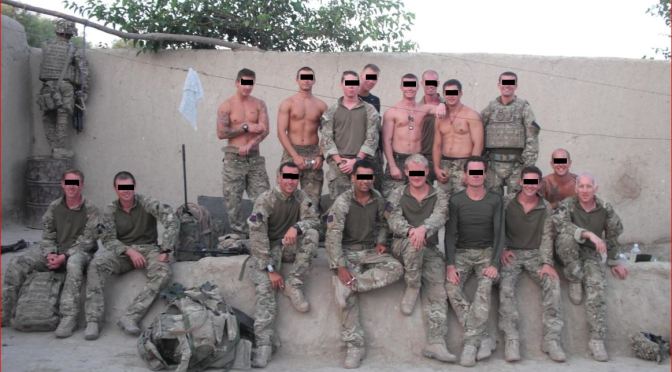
The headline photo is of Irish Guardsmen (motto: Quis Separabit) and me in Helmand Province in 2012.

The Calamities of War

The Guardian reports that ‘the US military in Afghanistan is increasingly trying to control public information about the war, resulting in strained relations with western organisations offering different versions of events to official military accounts.’

The suggestion is that the US military are trying to suppress ‘off-message’ accounts of civilian casualties in airstrikes. It wouldn’t be the first time in Afghanistan that ‘maintaining the narrative’ gets in the way of telling the truth.

As Samuel Johnson observed way back in 1758, ‘Among the calamities of war may be justly numbered the diminution of the love of truth, by the falsehoods which interest dictates and credulity encourages.’

SPIN ZHIRA: Old Man in Helmand is the unauthorised, unvarnished and irreverent story of one man’s midlife crisis on the front line of the most dangerous district in Afghanistan where the locals haven’t forgiven the British for the occupation of 1842 or for the Russian Invasion of 1979. Of course, all infidels look the same so you can’t really tell them apart.

‘The best book by a soldier concerning the Afghan War that I have read’
Frank Ledwidge, bestselling author of Losing Small Wars and Investment in Blood

‘SPIN ZHIRA vividly conveys the disjointed essence of modern warfare and the impossibility of balancing the adrenaline of combat with ‘normal’ life. This book brims with authenticity and dark humour.’
Patrick Hennessey, bestselling author of The Junior Officers’ Reading Club and Kandak

‘If you want to read about political and military success in Afghanistan, this book isn’t for you. If you want a fresh perspective from someone who is not a career officer and who is brave enough to bare his soul, then SPIN ZHIRA is a must read.’
Lt Col Richard Dorney, bestselling author of The Killing Zoneand An Active Service

‘Five stars’
SOLDIER The official magazine of the British Army

‘A journey of love, service and adventure. Excellent.’
Amazon Customer
Ten reasons why you should read SPIN ZHIRA.


Old Man in Helmand