I turned 51 this month. This means I am now officially too old to serve in an operational combat role without generating a lot of additional paperwork. To celebrate my new non-combatant status I attempted a British Army personal fitness assessment (PFA). I’ve been doing PFAs since 1985 and old habits are hard to break. Back then they were called the BFT – basic fitness test. As the original name suggests it’s a measure of the minimum standard of fitness required to be a British soldier.
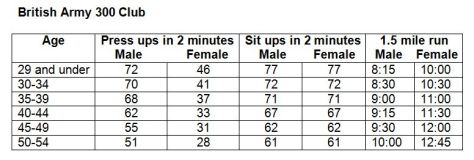
The test itself is simple enough and requires the individual to complete as many press ups as possible in two minutes, followed by as many sit-ups in two minutes followed by a best effort mile and half run. Soldiers must achieve a minimum standard according to age and gender as outlined in the table below:
For those soldiers who aspire to more than the bare minimum, which is almost everyone, there is a second benchmark known as the 300 Club. Passing into the 300 Club requires a much higher standard of fitness as follows:
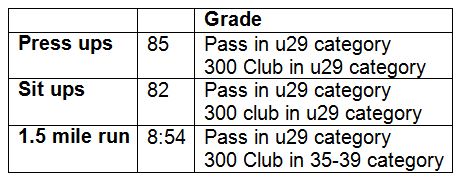
Naturally, like everyone else, I’ve always aspired to be in the 300 Club. Here’s how I got on:
There was a time, about 30 years ago, when I could comfortably run a mile and a half in under eight minutes but these days I’m happy to settle for sub nine. After all, I am getting on a bit.
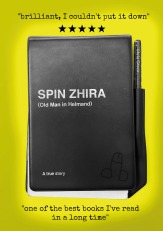
SPIN ZHIRA: Old Man in Helmand is the unauthorised, unvarnished and irreverent story of one man’s midlife crisis on the front line of the most dangerous district in Afghanistan where the locals haven’t forgiven the British for the occupation of 1842 or for the Russian Invasion of 1979. Of course, all infidels look the same so you can’t really tell them apart.
‘The best book by a soldier concerning the Afghan War that I have read’ Frank Ledwidge, bestselling author of Losing Small Wars and Investment in Blood
‘SPIN ZHIRA vividly conveys the disjointed essence of modern warfare and the impossibility of balancing the adrenaline of combat with ‘normal’ life. This book brims with authenticity and dark humour.’ Patrick Hennessey, bestselling author of The Junior Officers’ Reading Club and Kandak
‘If you want to read about political and military success in Afghanistan, this book isn’t for you. If you want a fresh perspective from someone who is not a career officer and who is brave enough to bare his soul, then SPIN ZHIRA is a must read.’ Lt Col Richard Dorney, bestselling author of The Killing Zone and An Active Service
‘Five stars’ SOLDIER The official magazine of the British Army
‘A journey of love, service and adventure. Excellent.’ Amazon Customer
This Sunday, come rain or shine, the British people, young and old, left and right will gather together at War Memorials up and down the country to honour those who have sacrificed their lives in the service of their country.
Shortly after 11am the fourth stanza of a poem written by Laurence Binyon in September 1914 will conclude the Act of Remembrance and we shall return to our daily lives for another year:
They shall grow not old, as we that are left grow old: Age shall not weary them, nor the years condemn. At the going down of the sun and in the morning We will remember them.
Ever since I was a boy, younger even than my own boys are now, I have attended the Remembrance service and over the years I’ve come to know the words by heart. But since I returned from Afghanistan in September 2012 I have been guided by a different poem and a different purpose:
When you go home tell them of us and say For your tomorrow we gave our today
It was these words that were used to conclude vigil services held to honour fallen comrades in Afghanistan. For those of us who were there and who have now safely returned home they are not just words but a lifelong obligation.
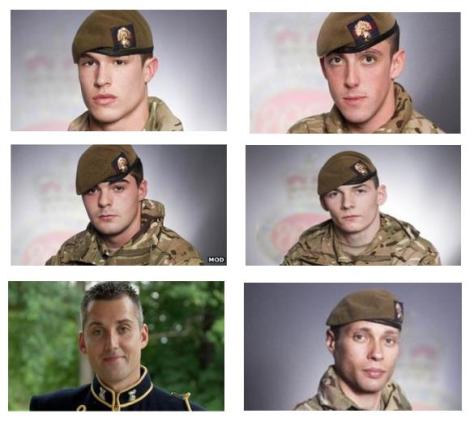
Friday, 27 April 2012: Guardsman Michael Roland
Wednesday, 13 June 2012: Lance Corporal James Ashworth
Friday, 17 August 2012: Guardsman Jamie Shadrake
Friday, 7 September 2012: Guardsman Karl Whittle
Sunday, 9 September 2012: Sergeant Lee Paul Davidson
Friday, 14 September 2012: Lance Corporal Duane Groom
Five years ago this month, Corporal Sean Jones of C Company, the Princess of Wales Royal Regiment led a bayonet charge, along with three other men, onto a Taliban position in the village of Kakoran.
Corporal Jones’ action that day earned him a well deserved Military Cross for ‘extraordinary leadership in the face of extreme and tangible danger’.
He would later state that the way his patrol dealt with the Taliban also improved relations with the villagers they were trying to protect. ‘Before this, the locals were wary of us, but this showed they could trust us to protect them from the enemy and that we wouldn’t endanger them while doing it… We built good relationships, chatting to them on patrols, kicking balls around with the children. They knew the Taliban could no longer enforce curfews on them and things got much better with their way of life.’
1PWRR on patrol in Afghanistan (inset Sean Jones)
Sadly, any improvements were short-lived. Five months later I would join the men of C Company on their last patrol into Kakoran:
‘Patrol Base Clifton sits atop high ground just outside the green zone overlooking a rural community which has not changed much in the last 500 years. Families live in walled compounds made of mud and straw, side by side with their livestock. They have none of the creature comforts we take for granted in the West. Despite these privations it has a certain rustic beauty. Fields are carefully tended, watered by a delicate and intricate irrigation system which provides an ever‑present, soothing soundtrack of flowing water. Whitewashed compounds are shaded by magnificent mulberry trees which stave off the relentless heat of the Afghan summer.
In stark contrast to the dashte in the north, the land is fertile. The favourable climate and an abundance of water enable three growing seasons each year. Farmers harvest poppy in April, wheat in June and maize in September. Poppy, however, is the main source of income and this illicit trade binds the community to an insurgent narco‑nexus which facilitates the movement of wet opium to markets in Gereshk, and as far afield as Pakistan and Iran.
Over the past six months C Company has made numerous attempts to gain access to Kakoran and its sister kalay of Narqiel a few clicks further south. All have resulted in ‘kinetic activity’ – the military euphemism for the use of lethal force. Further east in the kalay of Adinzai insurgents have been observed routinely gathering at a tea shop in the local bazaar, openly carrying their weapons without fear of reprisals. This group of young bandits is known to be especially wild and fond of violence and is informally labelled the ‘Crazy Gang’ by our J2 (Intelligence) cell.
Back in the UK Captain Alex Bayliss, our Intelligence Officer had described this area to me as the ‘Taliban Heart of Darkness’. It’s a place where brown underpants are a sensible precaution.
We continue to patrol down into the green zone where we go firm on the side of a dirt road beside an Afghan National Army (ANA) checkpoint which is surrounded on all sides by poppy fields. The ANA lads look bored, wandering around in flip‑flops and t‑shirts, pretending to ignore what we’re up to. Someone is preparing a meal while another man splits logs with a lump hammer and a metal stake. No one is manning the machine gun or carrying weapons.
A battered white Nissan pulls up and five or six lads get out. Although they’re in civvies they’re obviously part of the gang. There’s lots of hugging and fast talking. I’m curious to know how an ANA soldier can afford to own a motor vehicle but I keep that thought to myself. In the distance I see men labouring in the poppy fields in a slow, measured way that suggests they’re pacing themselves for a lifetime of hard manual labour. Nothing much has changed here for centuries it seems, so there’s no great rush to get anything done.
It’s obvious that everyone is watching us and waiting to see what our next move will be. After about 30 minutes we’re given the order to move and head out across the fields towards some compounds about 200 metres distant. We’re following a safe lane cleared by a Vallon operator and marked by his number two with blue spray paint. It’s a slow but essential process; Improvised Explosive Devices (IEDs) are the insurgents’ weapon of choice and the number one source of ‘Category A’ casualties amongst ISAF and ANA soldiers. A Cat A is defined as a life threatening injury which requires urgent medical attention within 90 minutes.
At first the going is pretty straightforward but as we move deeper into the green zone the ground becomes heavily waterlogged. Progress gets tougher and tougher as mud oozes over the tops of our boots, then up to our knees. It’s almost impossible to mark a safe lane in this sea of liquid mud but I take consolation from the fact that it would be equally near impossible to maintain the integrity of a battery pack, an essential component of any IED, in this volume of water.
By the time we reach the tree line I’m blowing hard and covered in filth – there’s a dodgy stench about me that may or may not be human excrement, which the locals routinely recycle onto their fields. I try not to think about it. Grateful for the camelback I was issued at the Reserve Training and Mobilisation Centre in Chilwell, Nottingham, I suck down some deliciously cool water through the drinking tube clipped to the front of my body armour.
We go firm in the tree line and scan our arcs. There are plenty of local nationals who have come out to watch the show. For us it’s a good sign because it suggests that the insurgents haven’t warned them to stay away, but we’re not letting down our guard. A number of shifty looking blokes of fighting age are having a bit of a chin wag about 300 metres away. One of them is clearly talking into a mobile phone. A couple of motorbikes are also whizzing up and down a track on our left and appear to be keeping tabs on our movements.
In order to get a clearer picture of what’s going on we decide to push forward across another field, but first we have to cross an irrigation ditch. It’s full of waist deep murky brown water with steep banks on either side. There’s no way to jump across with all the kit we’re carrying. In any case it’s a vulnerable point which will have to be cleared by the Vallon.
The insurgents are experts at identifying likely crossing points such as this and placing IEDs in the banks to catch unwary soldiers as they climb in or out. As we clear the ditch the guy behind me struggles to find a foothold on the slippery bank. I lend him a hand and he nearly pulls my arm from its socket as he hauls himself out. Unbalanced, I take a step backwards and stumble before falling headlong down the other side of the bank. I try desperately to stay in the safe lane but to no avail. We’ve been told that 90% of IED casualties are caused by straying out of lane. This time my luck holds but my underpants are going to require an intensive wash cycle.
In the short time it’s taken us to clear the ditch the atmospherics have changed. Women and children can be seen fleeing from the two compounds immediately to our front, herding their livestock in front of them. The likely lads we saw earlier have now split into two groups. One of our blokes sees what he thinks is a long‑barrelled weapon being taken into one of the compounds. These are all sure fire indicators that we’re about to be taken on and we now assess these two compounds to be the most likely direction of any threat.
In a procedure the C Company men call ‘advance to ambush’ we continue to move towards the compounds, expecting to come under fire at any moment. I repeatedly check the safety catch on my assault rifle with the index finger of my right hand but resist the temptation to slip it to ‘off’. Unless I’m unlucky enough to be hit by the initial burst of fire, in which case it’ll make no difference anyway, there’ll be plenty of time to depress the safety as I sight the weapon.
In these moments my focus on the compound is absolute. I no longer register the smell of human excrement encrusted on my combat trousers or the pain of blisters forming inside my waterlogged boots. I am unaware of the weight of my backpack compressing the blood supply to my left arm or the constant chafing of ballistic plates over my salt‑rimed skin.
My existence has narrowed to a set of binary choices: Live or die; hunt or be hunted; kill or be killed. These moments are the culmination of hundreds, if not thousands of hours of training which have consumed almost every waking hour of my life for the past 18 months. It is for these few precious minutes that I’ve turned my back on a lucrative career, abandoned my comfortable suburban existence, my beautiful wife, my trophy house, my exotic bi‑annual holidays.
I‘m not disappointed. The simplicity is exhilarating.
I’m taking a long hard look at the compound wall, trying to identify any likely firing points or murder holes, when there is a huge explosion. My first thought is that one of us has initiated an IED but then I see smoke billowing from the compound. Perhaps it’s an IED own goal.
But less than 30 seconds later I hear the distinctive sound of rotor blades and turn to see an Apache attack helicopter approach from behind us at about 500 feet. It has fired a Hellfire missile right through the open window of the compound’s main building. Now it follows up with a long burst of 30mm cannon. I take a knee and watch as the building appears to disintegrate into a cloud of dust in front of us.
After the intensity of the preceding moments I feel strangely impassive but, given that we are between the Apache and its target, it crosses my mind that now would not be a good time for the pilot to sneeze.
We learn later that, undetected by us or by the likely lads, the Apache pilot had come on station a few minutes earlier. From his vantage point, unseen and unheard five klicks behind and above us, the pilot had been able to see what we could not see from less than 150 metres away on the ground. He had positively identified two shooters about to open fire and under ISAF rules of engagement he had permission to make a pre‑emptive strike on the basis of imminent threat to life. In this case our lives.’
It was to be the first of many patrols I would make into Kakoran and the surrounding area. Over the course of the next few months four Guardsmen would be killed and many others wounded in action there, often in bitter close quarter combat.
History shows that the locals were right to be wary of ISAF soldiers. We proved unable to protect them and even before the British departure from Helmand Province in 2014, Kakoran returned to Taliban shadow governance. GIRoA has no presence or authority there.
SPIN ZHIRA: Old Man in Helmand is the unauthorised, unvarnished and irreverent story of one man’s midlife crisis on the front line of the most dangerous district in Afghanistan where the locals haven’t forgiven the British for the occupation of 1842 or for the Russian Invasion of 1979. Of course, all infidels look the same so you can’t really tell them apart.
A JOURNEY OF LOVE, SERVICE AND ADVENTURE. EXCELLENT!
A MODERN WARFARE LITERARY CLASSIC! OUTSTANDING READ.
ENTERTAINING, THOUGHT-PROVOKING AND COMPULSORY TO READ.
Over the weekend we learned from The Spectator that over 6,000 new cases of female genital mutilation (FGM) were reported by NHS staff last year (tens of thousands more are thought to go unreported). Despite being illegal in the UK since 1985, despite the appalling scale of the abuse, there has not been a single conviction for this terrible betrayal of a child’s love and trust in her parents.
Meanwhile the broadsheets, led by The Telegraph, report that Michael Fallon, the Defence Secretary barely suppresses his anger when he talks about criminal investigations into alleged abuse in Iraq and Afghanistan by British troops. He has pledged to provide legal support to servicemen under investigation, but omits the rather obvious point that it is his ministry which funds these enquiries with taxpayers money (expected to exceed £57m by 2019).
Not a single case has been brought to trial much less resulted in a conviction but instead of shutting it down Mr Fallon hides behind European Human Rights laws and extends the remit of the investigation. Meanwhile, not a single one of our European partners in NATO feels the need to hold enquiries of similar scale into the actions of its military in Iraq and Afghanistan. Mr Fallon’s failure to act decisively is another example of what David Cameron described elsewhere in the news as his ‘lily livered cabinet colleagues’ failing to confront their ministerial responsibilities.
But I have a radical idea. Why not divert the funds and the investigators talents to an issue where a terrible injustice is being perpetrated against children, where there is irrefutable evidence of abuse and where an investigation is urgently needed to eradicate the illegal practice of female genital mutilation. Even Mr Fallon can agree that defending the innocence of children is a better use of resources.
SPIN ZHIRA: Old Man in Helmand is the unauthorised, unvarnished and irreverent story of one man’s midlife crisis on the front line of the most dangerous district in Afghanistan where the locals haven’t forgiven the British for the occupation of 1842 or for the Russian Invasion of 1979. Of course, all infidels look the same so you can’t really tell them apart.
A JOURNEY OF LOVE, SERVICE AND ADVENTURE. EXCELLENT!
A MODERN WARFARE LITERARY CLASSIC! OUTSTANDING READ.
ENTERTAINING, THOUGHT-PROVOKING AND COMPULSORY TO READ.
On 24 September 2012 at 3.30pm, after nine long months in Helmand, I was finally reunited with my children, Harry and Alfie. It was an unforgettable moment of realisation that changed my life forever.
‘AS I HURRY from my train at London Bridge station I glance at my Citizen Divers watch, my constant companion of the last 20 years.
I don’t want to be late for this appointment.
I notice that the black canvas military strap I fitted before departing for Afghan is caked in Helmand Province. Until this moment I’ve been oblivious to this but it’s impossible to miss against the cuff of the white dress shirt I’m wearing under my velvet blazer.
Save for my watch, I’m in full civilian mode, completely invisible amongst the multitude of commuters who criss‑cross the station’s concourse. Except, perhaps, that where they stride with confidence and purpose along unseen tramlines of relentless repetition my own trajectory is less certain. I’m an untethered element cast adrift in the throng.
I make my faltering way to the exit on London Bridge Street where The Shard towers above the railway lines that inspired it. The vast obelisk of glass and steel is a monument to a world of consumerism and excess that I turned my back on, but which I’ve been fighting to protect.
The irony is lost on me. At any moment two beautiful boys will appear at the station entrance and I’m straining to catch my first glimpse of them in the crowd.
Jane and I have been unable to agree on a reunion prior to this moment. Harry and Alfie are not waiting for the plane to touch down at RAF Brize Norton as I’d often daydreamed they might be. Nor are they present when our coach is mobbed by excited families as it swings onto the parade square at Lille Barracks in Aldershot – the start and end point of my Afghan Adventure.
I’ve been a forlorn bystander as colleagues push past me to embrace their partners or bundle their delighted children into their arms. Banners, balloons and even cakes are exchanged along with a multitude of kisses. Some affectionate, some passionate, some X‑rated, but all of them heartfelt. Alone in this welter of excitement, I make my way through the happy throng and head disconsolately towards the camp exit. It dawns on me that I don’t know where I’m going.
I keep walking.
As part of my mandatory ‘decompression’ programme I’m required to spend the next 48 hours on the base. But there’s no accommodation for me. Eventually I’m quartered in a condemned block that is awaiting demolition in another part of the garrison. It is eerily silent, cold and gloomy and matches my mood perfectly.
General George Patton warned that Glory is fleeting. This doesn’t feel like an especially warm welcome from a grateful nation.
In the end it is my sister, Edwina who comes to the rescue. As soon as I’m released from my military bonds of service she takes a day off work to travel to York and collect the boys. We’re in constant contact throughout our respective journeys and so, by accident rather than design, our rendezvous is a railway station. I can’t think of a better location for a reunion.
I catch a glimpse of Harry weaving through the crowd a split second before he’s airborne and hurtling towards me at speed. I have just time to catch him in my arms but not quite enough time to stay on my feet. I go down hard, but the cold stone platform is a feather bed in the joy of that moment. Alfie is only a few paces behind his brother and with a glorious cry of BUNDLE! jumps knees first onto my chest.
We roll around on the floor for a while, just as we’d done on the lawns of Gooseberry Hall five months earlier, oblivious to the commuters who step around and over us. My wonderful sister, who has made it all possible, stands back and allows us to revel in the occasion.
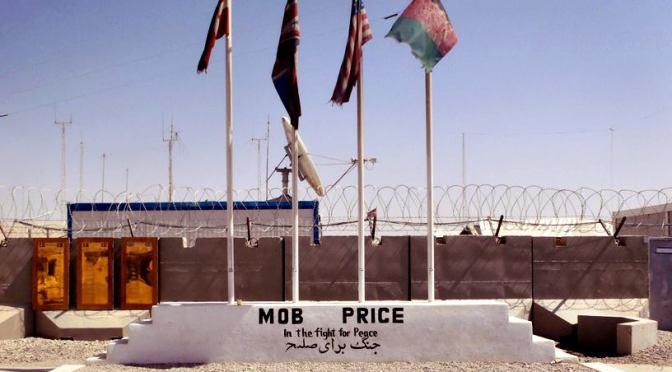
The journey that started at the MOB Price helipad six days and 4,457 miles earlier is finally over.
I’m home at last.
In the years before I became disillusioned with my life of comfortable consumerism I would wake at 5.15am each workday morning in order to fund our pointlessly extravagant existence. In those days Harry and Alfie would often sleep in our bed and I would lie in the dark for a few minutes, enjoying the warmth of my family beside me. It increasingly became the highlight of my day and I wondered why I needed such a large house and quite so many belongings when everything in the world that actually mattered fitted comfortably within the precinct of our double bed.
As Harry and Alfie turn me black and blue with their love on the station concourse, I realise I’ve been right all along to exchange possessions for experiences. I haven’t missed my designer clothes, my trophy house or my luxury goods even once.
Being reunited with my children, on the other hand, is an unforgettable moment that I will treasure for eternity.’
SPIN ZHIRA: Old Man in Helmand is the unauthorised, unvarnished and irreverent story of one man’s midlife crisis on the front line of the most dangerous district in Afghanistan where the locals haven’t forgiven the British for the occupation of 1842 or for the Russian Invasion of 1979. Of course, all infidels look the same so you can’t really tell them apart.
A JOURNEY OF LOVE, SERVICE AND ADVENTURE. EXCELLENT!
A MODERN WARFARE LITERARY CLASSIC! OUTSTANDING READ.
ENTERTAINING, THOUGHT-PROVOKING AND COMPULSORY TO READ.
The Telegraph reports that the Ministry of Defence has extended the remit of the Iraq Historic Allegations Team (IHAT) to include investigation into alleged abuse in Afghanistan.
In addition to the 1,500 Iraqi cases already under investigation a further 550 alleged Afghan war crimes have been added to the IHAT caseload.
As Iraq cases begin to dry up without a single successful conviction, extending the investigation to Afghanistan preserves the gravy train for the IHAT investigators for a few more years. But I sense a darker motive for squandering taxpayers money and causing unnecessary misery for those individuals and their families who have been accused of wrongdoing.
Investigating individual allegations of abuse deflects the spotlight away from the strategic failure of the Iraq and Afghan campaigns. This sits squarely with the policy makers and doctrine writers at the Ministry of Defence and the Foreign Office who sanctioned the tactics of drone strikes, kill/capture missions and detention without charge or access to legal representation, sometimes on the flimsiest of evidence.
For the most part, British soldiers carried themselves with great dignity and showed incredible courage and restraint. It is the flawed counter-insurgency doctrine and strategy that has thrown the Middle East into chaos and caused untold misery and suffering that needs to be investigated.
SPIN ZHIRA: Old Man in Helmand is the unauthorised, unvarnished and irreverent story of one man’s midlife crisis on the front line of the most dangerous district in Afghanistan where the locals haven’t forgiven the British for the occupation of 1842 or for the Russian Invasion of 1979. Of course, all infidels look the same so you can’t really tell them apart.
A JOURNEY OF LOVE, SERVICE AND ADVENTURE. EXCELLENT!
A MODERN WARFARE LITERARY CLASSIC! OUTSTANDING READ.
ENTERTAINING, THOUGHT-PROVOKING AND COMPULSORY TO READ.
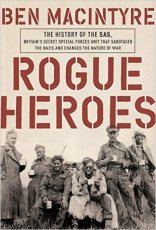
A new book, Rogue Heroes by Ben MacIntyre, is published today charting the early days of the Special Air Service.
It reveals how the organisation, which has been shrouded in mystery since its inception in 1941, survived numerous ‘cock-ups’ and obstruction from the army’s upper echelons to become the world-renowned force it is today.
It also reveals that many of its secretive missions behind enemy lines included, in the words of its founder, David Stirling ‘executions in cold blood’.
‘Towards the end of our tour a night raid in Rahim, conducted by a joint SAS and Afghan Special Forces team (TF196), resulted in three brothers being gunned down in their compound in front of their wives and children.
Again I found myself in conflict with British Tier One Special Forces. TF196 insisted the men were insurgents, but this claim seemed highly improbable to me. The brothers’ compound was just a short distance from one of our patrol bases and any suspicious activity would almost certainly have come to our attention. Our own J2 Shop had nothing on the men. The general consensus from our analysts was that the SAS, while ruthlessly efficient as always, had directed their special talents against the wrong targets.
When I challenged a TF196 spokesman on their version of events he played their top secret joker once more. Speaking to me by phone from an undisclosed location he said the information was classified. As a known Taliban‑loving apologist and mere part‑time soldier I could not be trusted and had no authority to contradict elite tier one special forces. A short while later I received another telephone call from the charming colonel in Task Force Helmand (TFH) ordering me to drop my line of enquiry. Although he remained amiable I detected a hardening in his tone.
The TFH top brass had silenced me, but the Rahim ‘spin zhiras’ remained determinedly voluble on the subject. They steadfastly maintained the brothers’ innocence and were outraged at the brutal executions in front of the victims’ families. Emissaries were despatched to the patrol base threatening retaliation and demanding an apology and blood money for the relatives. The PB Commander was bitterly angry that the raid had gone ahead without his knowledge, destroying the work his own men had done over the previous six months to marginalise the Taliban and protect the population from insurgent violence.
Shortly after we completed our tour the Rahim patrol base was abandoned and Afghan National Security Forces ceded control of the area to the Taliban. Perhaps these events were not linked to the slaying of the supposed insurgents but, given the long memories of our Afghan hosts, this seemed unlikely to me. Our actions had done nothing to strengthen the legitimacy of the GIRoA government as the Petreus COIN Field Manual had directed.
SPIN ZHIRA: Old Man in Helmand is the unauthorised, unvarnished and irreverent story of one man’s midlife crisis on the front line of the most dangerous district in Afghanistan where the locals haven’t forgiven the British for the occupation of 1842 or for the Russian Invasion of 1979. Of course, all infidels look the same so you can’t really tell them apart.
Army Sergeant Major Glenn Haughton, the senior non-commissioned officer in the British Army has recently published a set of six ‘Green Lines’. He describes them, not as a code or test but ‘the lines that I try and live by every single day’.
Glenn was the “Sarn’t Major” in Afghanistan, a man I feared and respected in equal measure.
I see from his lines that it must be from him that I developed a deep mistrust for any man in uniform whose appearance might indicate an inability to meet mandated fitness requirements:
‘TEN MONTHS AFTER returning from Afghanistan I attended an Armed Forces Day parade at which I found myself standing next to two hugely overweight TA captains from another unit. To me they looked ridiculous, bulging out of their uniforms, Sam Browne belts straining to contain enormous bellies, rolls of fat flowing over their shirt collars. By this time I’d been conditioned by the Grenadiers to take an instant dislike to any man in uniform whose appearance might indicate an inability to meet mandated fitness requirements. These two were so vast they would struggle to find Taliban Hunting Club t‑shirts in their XXXXL size.
Given the occasion, and in the interests of inter‑unit cohesion, I bit my tongue and introduced myself. Ignoring my rank seniority they looked me up and down and resumed their conversation. Standing beside them I could not help but overhear their discussion. Unchecked by my presence they were making offensive and deeply critical comments about a female senior officer who was leading their unit’s marching contingent. It was clear they both felt that a ‘lumpy jumper’ was not up to this task and that they could do a better job themselves. Since they were not only obese but also overtly and crudely sexist, I was unable to resist the invitation I felt they’d just given me. I interrupted them, asking which part of the HQLF directive on physical fitness they had failed to understand.
They looked at me blankly.
“Come on fellas”, I said. “Take a look at yourselves. When was the last time you pulled on a pair of shorts and went for a run? No one’s going to let you lead a parade while you both look like Mister fucking Blobby.”
Both men wore Afghanistan medals, along with a clutch of others that indicated many years service in the reserves. For all I knew they performed some vital role, repairing shattered lives in the Bastion hospital perhaps. It was possible they had once been flat-bellied, steely eyed killers who had let themselves go – although this really was stretching credulity. I should certainly have exercised better judgement myself, admonishing them for their inappropriate comments rather than countering with a few of my own, but HQLF is right. Physical fitness is an indispensable aspect of leadership. These two, however crucial their individual efforts were in the defence of the realm, had long ago relinquished the right to lead or command soldiers, even on a public parade in central London, let alone anywhere near the sharp end of British foreign policy.
Their stunned reaction to my outburst was to be short‑lived. I observed them a couple of hours later merrily stuffing their faces at the buffet lunch laid on by the local authority to celebrate the ‘outstanding contribution made by our Armed Forces’. I knew I was a victim of my own prejudice, just as they were of theirs, but I couldn’t help but feel resentment that these two were cashing in on the heroism of others. I uncharitably reckoned that their outstanding contribution had most likely been to Pizza Hut revenues at Camp Bastion.
Later that day, as a media trained officer I was tasked to give a television interview to Ria Chatterjee for ITV London. Ria is a very attractive young woman and I was a little distracted by her beauty. I stumbled through a series of rambling responses to her questions, full of ‘ums’ and ‘ers’, all of which I knew would be unusable in the two minute segment she was preparing. Concealing her frustration at the incompetent spokesperson with whom she’d been saddled, Ria eventually asked me why Armed Forces Day should be important to the people of London. I told her it was an opportunity to show some solidarity with the men and women of the armed forces – who put themselves in harm’s way to keep others safe. It wasn’t a perfect delivery but it was a good enough answer and Ria used it to close out her report.
Even as I spoke the words I couldn’t find it in myself to apply them to the two chauvinist Blobby’s gorging themselves in the marquee behind me.’
SPIN ZHIRA: Old Man in Helmand is the unauthorised, unvarnished and irreverent story of one man’s midlife crisis on the front line of the most dangerous district in Afghanistan where the locals haven’t forgiven the British for the occupation of 1842 or for the Russian Invasion of 1979. Of course, all infidels look the same so you can’t really tell them apart.
Writing in The Telegraph, Johnny Mercer MP reveals a terrible betrayal of our servicemen and women by the Ministry of Defence, the organisation that claims to support them.
He refers to the Iraq Historic Allegations Team (IHAT) a £5m/year gravy train for ex-coppers set up by the Ministry of Defence to investigate allegations of abuse, torture and murder of Iraqis by British servicemen. Currently there are some 1,500 on-going investigations, which as Johnny rightly points out, would imply ‘a total breakdown of law and order on an unprecedented scale across the British Army in Iraq’. It doesn’t take more than two brain cells to see that an investigation of this scale is totally disproportionate.
However, even in war, soldiers are not above the law. Discipline and standards are maintained on the battlefield through strict adherence to the Law of Armed Conflict. Consequently, it comes as little surprise to me that, even after such a thorough review of alleged abuse, not a single IHAT case has been brought to trial or resulted in a successful conviction.
Inexplicably, instead of winding down the IHAT investigation and celebrating the quality of its men and women, the Ministry prefers to keep the gravy train running and soldiers now find they are subject to a second and in some cases even a third investigation. Squandering taxpayers money and causing unnecessary misery for those involved.
SPIN ZHIRA: Old Man in Helmand is the unauthorised, unvarnished and irreverent story of one man’s midlife crisis on the front line of the most dangerous district in Afghanistan where the locals haven’t forgiven the British for the occupation of 1842 or for the Russian Invasion of 1979. Of course, all infidels look the same so you can’t really tell them apart.
In response to a leaked memo in which General Sir Richard Barrons outlines his concerns that the UK is ill-prepared to defend against a serious military attack a defence source suggested this was ‘sour grapes‘ after Sir Richard was turned down for promotion to head of the armed forces.
When fat cat, Sir Bernard Grey was awarded a £60,000 ‘non-competitive’ deal to conduct a performance review on himself, an MoD spokesperson stated this would ‘provide best value for money’.
When an unfavourable report submitted to the MoD recommended an urgent review of its £440 million contract with Capita because it was failing in its recruitment mission the ministry responded by stating ‘action has been taken’.
When the Defence Select Committee lambasted the MoD for continuing to issue anti-malarial drug, Lariam to troops stating it should be used only as the drug of last resort, the MoD responded: ‘We have a duty to protect our personnel from malaria and we welcome the committee’s conclusion that, in some cases, Lariam will be the most effective way of doing that.’
When General Sir Richard Shirreff, the former deputy supreme allied commander in Europe (DSACEUR) expressed his opinion that cuts in UK defences were ‘a hell of a gamble‘ the MoD’s response was to state: ‘This guy has made a series of outlandish claims over the years. He’s trying to sell a book, so you have to expect such outbursts.’
On its website the Ministry of Defence claims to be a listening organisation. I leave you to draw your own conclusion.
SPIN ZHIRA: Old Man in Helmand is the unauthorised, unvarnished and irreverent story of one man’s midlife crisis on the front line of the most dangerous district in Afghanistan where the locals haven’t forgiven the British for the occupation of 1842 or for the Russian Invasion of 1979. Of course, all infidels look the same so you can’t really tell them apart.




 A JOURNEY OF LOVE, SERVICE AND ADVENTURE. EXCELLENT!






 SPIN ZHIRA