All posts by chrisdsgreen

Redacted#2

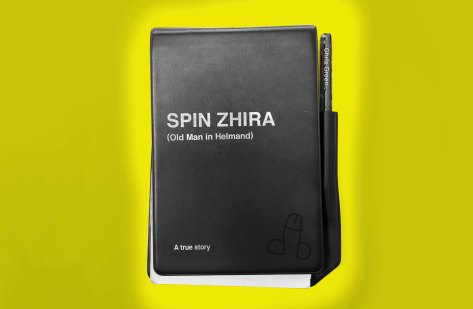
Front cover for Facebook

When I first set out to write a book about my experiences in Afghanistan I was informed by Army Media Communications that it could not:

Criticise our allies, other Government Departments or past/current Prime Ministers.

Include anything that would undermine the Army’s reputation.

Since I planned to do all these things it became immediately apparent that, in order to escape censorship, I would have to leave the army reserve.

I now find myself subject to censorship from an unexpected quarter.

Facebook.

Initially there was some, not unreasonable, objection to the doodle on the front cover of my notebook. This was resolved with gaffer tape.

However, the Facebook censors have also determined that the book’s title is unsuitable. With good reason Facebook insists that “posts can’t contain profanity, harassment, or references to your audience’s personal characteristics (such as gender, race, age or name).” 

So, it turns out that ‘Old Man’ was a little too personal and has now been redacted from the Facebook page name and profile image. However, the book itself remains unapologetically unchanged.

Visit the Amazon Kindle store to see what all the fuss is about.

I can’t help but wonder what Mark Zuckerberg would make of this? Facemash, the precursor to Facebook was shut down after it was deemed inappropriate.

SPIN ZHIRA: Old Man in Helmand is the unauthorised, unvarnished and irreverent story of one man’s midlife crisis on the front line of the most dangerous district in Afghanistan where the locals haven’t forgiven the British for the occupation of 1842 or for the Russian Invasion of 1979. Of course, all infidels look the same so you can’t really tell them apart.

Improvised Explosive Device


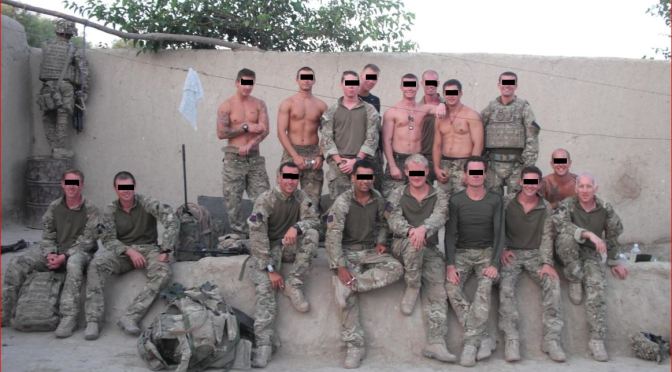
Yesterday, as the Invictus Games were concluding in Orlando,  I joined an email thread between two readers, one in London and the other in Thailand (my only reader in Thailand so you know who you are). They were discussing Improvised Explosive Devices (IEDs). It was impossible not to reflect that many of the Invictus competitors are the victims of IEDs and have overcome terrible injuries to compete for their country. In my book I have tried to provide an insight into what all soldiers endured as they patrolled the badlands of Helmand Province:

“As the Grenadiers or fighting Ribs1 of Inkerman Company knew only too well, living with the constant possibility that your every next step may trigger an IED slowly and inevitably degrades the human spirit. It pervades every waking moment and is a constant and exhausting factor. Every breath must be carefully savoured lest it be your last. Every footfall must be critically considered and evaluated before being placed. Each tread is committed with unyielding trepidation. The euphoria of one safe step is immediately replaced by apprehension at the next and so on and so on until …

According to Aristotle, ‘Fear is pain arising from the anticipation of evil.’ Not being as erudite as the great Greek polymath, for me, fear is the ever‑present possibility that my fellow man has carefully concealed a yellow palm oil container packed with a volatile mixture of ammonium nitrate and aluminium in the ground beneath my feet. It is the screaming anticipation that my very next step will initiate this crude mixture and a dark and powerful blast will remove my legs and my manhood and leave me bloodied and broken in the dirt.

As friends and colleagues fall victim to these devices and are forever mutilated or killed in circumstances or locations you have visited yourself, it becomes possible to reflect not that you have been lucky, but that you must be next. It’s a conviction that slowly and inexorably takes hold in the darkest recesses of your exhausted mind and grows like a malignant cancer.

During the course of my patrols in the Gap I witnessed young Guardsmen so overcome with fear that they would vomit at the front gates of the base before bravely stepping off on a patrol they have convinced themselves will be their last. I have also seen men so exhausted by constant vigilance that they lose all reason and stumble about blindly, no longer caring if they live or die.

Both are equally distressing to observe. But in this I was not always a mere observer.

On one patrol I was myself so overwhelmed by the certainty that I was about to take my last few steps on this earth that I became rooted to the spot unable to move either forward or back. It took the gentle and patient persuasion of a better man half my age to guide me, temporarily broken and useless, to safety.

I would hear IEDs detonated by other callsigns, sometimes less than a kilometre distant. Or I would join a platoon for a few days, to learn soon afterwards that one of their number had been grievously wounded.

One device claimed the legs of another London Regiment soldier, Lance Corporal John Wilson with whom I’d trained and prepared for deployment, another took the foot of Jay, an SF soldier whom I’d got to know. Jay had postponed his end of tour date when yet more faults on the ageing RAF Tristar fleet had delayed his replacement’s arrival into theatre.

I tried to convince him that he didn’t need to go back out on the ground but he ignored my advice. When the news came through that his patrol had been whacked by an IED and had a serious casualty I instantly feared it must be him, and so it proved to be. Some reckoned he’d been lucky – the device only partially detonated and his injuries could have been much worse – but I knew that Jay’s luck had run out with his chuff chart2”

SPIN ZHIRA: Old Man in Helmand is available as an Amazon Kindle e-book

SPIN ZHIRA: Old Man in Helmand is the unauthorised, unvarnished and irreverent story of one man’s midlife crisis on the front line of the most dangerous district in Afghanistan where the locals haven’t forgiven the British for the occupation of 1842 or for the Russian Invasion of 1979. Of course, all infidels look the same so you can’t really tell them apart.

Yellow palm oil IED1Ribs/fighting Ribs: Inkerman Company, First Battalion The Grenadier Guards are known as the Ribs or fighting Ribs after their predecessors took part in the Anglo-Dutch Wars (1652-74) as marines, accommodated in the ship’s hold amongst the ribs.

2Chuff Chart: A chart or calendar used by servicemen and woman to count down the days until the end of a tour of duty.


Prince Harry: Role Model

Invictus Games Orlando 2016 - Behind The Scenes

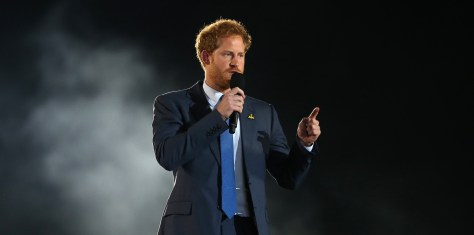
Prince Harry’s speech at the Opening Ceremony of the Invictus Games in Orlando | The Royal Family

It’s easy to see why Prince Harry has always been such a great role model for soldiers. He scraps outside nightclubs. He wears inappropriate fancy dress. He gets naked with beautiful young women. But he may just have surpassed all these prior achievements with this speech at the Invictus Games opening ceremony:

“Hello Orlando!

I cannot tell you how proud and excited I am to open the second Invictus games here in America.

I’m a long way from London tonight. But when I look out and I see so many familiar faces, servicemen and women, their friends and their families and all the people who have got them here – I feel like I’m at home.

I spent 10 years in the British Army and I was deployed to Afghanistan twice. I served alongside soldiers from all over the world. I saw the sacrifices you and your families made to serve your nations. I learned about the importance of teamwork and camaraderie in a way that only military service can teach you. And when I travelled back from the battlefield on a plane carrying the body of a Danish soldier and three young Brits, fighting for their lives, I began to understand the real, permanent cost of war.

I joined the Army because, for a long time, I just wanted to be one of the guys. But what I learned through serving was that the extraordinary privileges of being a Prince gave me an extraordinary opportunity to help my military family. That’s why I had to create the Invictus Games – to build a platform for all those who have served to prove to the world what they have to offer.

Over the next four days, you will see things that in years past just wouldn’t have been possible. You will see people who by rights should have died on the battlefield – but instead they are going for gold on the track or in the pool. You will be inspired, you will be moved, and I promise you will be entertained.

While I have your attention, though, I want to briefly speak about an issue that for far too many of you is shrouded in shame and fear. An issue that is just as important for many of you watching at home as it is for those of you in this stadium tonight.

It is not just physical injuries that our Invictus competitors have overcome. Every single one of them will have confronted tremendous emotional and mental challenges. When we give a standing ovation to the competitor with the missing limbs, let’s also cheer our hearts out for the man who overcame anxiety so severe he couldn’t leave his house. Let’s cheer for the woman who fought through post-traumatic stress and let’s celebrate the soldier who was brave enough to get help for his depression.

Over the next four days you will get to know these amazing competitors. They weren’t too tough to admit that they struggled with their mental health, and they weren’t too tough to get the help they needed.

To those of you watching at home and who are suffering from mental illness in silence – whether a veteran or a civilian, a mum or a dad, a teenager or a grandparent – I hope you see the bravery of our Invictus champions who have confronted invisible injuries, and I hope you are inspired to ask for the help that you need.

To end, can I just say thank you to all of you guys.

You are fierce competitors.

You are role models that any parent would be proud to have their children follow.

You’ve made me a better person. You are about to inspire the world and I’m proud to call you my friends.

So, let’s put on a hell of a show in memory of all of our fallen comrades who didn’t make it back.

We are Invictus!”

SPIN ZHIRA: Old Man in Helmand is available as an Amazon Kindle e-book

SPIN ZHIRA: Old Man in Helmand is the unauthorised, unvarnished and irreverent story of one man’s midlife crisis on the front line of the most dangerous district in Afghanistan where the locals haven’t forgiven the British for the occupation of 1842 or for the Russian Invasion of 1979. Of course, all infidels look the same so you can’t really tell them apart.

Old kit: New names

DESERT STORM
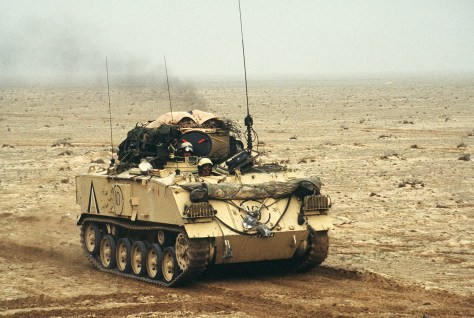
An FV-432 armored personnel carrier of the 7th Brigade Royal Scots, 1st United Kingdom Armored Division, crosses into Kuwait from southern Iraq during Operation Desert Storm.

As the Royal Artillery exhibit 100 years of artillery pieces at a historical display marking their 300th anniversary I wonder how many are still in service:

“MY FIRST ASSIGNMENT with my new regiment was to attend the two week annual training package, or ATP as it is known. Every TA unit is expected to undertake two weeks of collective training each year. The London Regiment had elected to conduct its ATP at RAF St Mawgan, near Newquay in Cornwall. It wasn’t entirely clear what my duties would be but this didn’t seem to matter so long as I turned up with all the kit with which I had recently been issued.

The year prior to my leaving regular service in 1996, the army had introduced new clothing and personal equipment which had been collectively labelled ‘Combat ‘95’. Like the rest of the British public, I was aware of the debate about under‑resourcing in the army. Hardly a day went by without talk of the inadequacy of Snatch Land Rovers, or the shortage of helicopters in Afghanistan.

The debate was vividly brought home to me by my kit issue.

In the 15 years I’d been away there appeared to have been no upgrades or improvements to Combat ‘95, other than there seemed to be less of it. ‘Barrack dress’ and ‘lightweights’ had been removed as orders of dress, as had the Jersey, Heavy Wool – which was probably a good thing. Although Nuclear, Biological and Chemical (NBC) protective clothing had been rebranded as Chemical, Biological, Radioactive and Nuclear (CBRN), it was otherwise unchanged and in any event was ‘dues out’ and not available for issue.

I was later to discover that giving old bits of kit new names was a recurring theme. The ancient FV432 armoured personnel carrier, a relic of the 1960s Cold War, had returned to service as the ‘Bulldog’. The Lynx helicopter, somehow forced upon the British Army by Westland in a deal dating back to the 1970s, was now the ‘Wildcat’.

The Lynx was originally much loved by pilots for its ability to do a barrel roll. This feature made it tremendous fun to fly, but turned out not to be a battle winning capability and did little to compensate for its failings. It was too small to be an effective troop carrier, and lacked the integrated weapon systems of an attack helicopter. It had first come in to service in the year Showaddywaddy topped the charts with You got what it takes but as a military helicopter it could never aspire to the title of that particular hit single.

A Lynx would later get me out of trouble whilst on a fighting patrol in the insurgent stronghold of Zumbalay. Following a pre‑dawn infiltration to probe enemy strengths and dispositions our presence had proved unpopular with the local Taliban. A number of small arms engagements ensued before the insurgents succeeded in blocking our exfiltration route. It was time to call for some air support and an Apache attack helicopter, callsign Ugly, was requested.

The Ugly is an awesome killing machine and the Taliban know better than to try and take it on. Its presence alone would be enough to make them go to ground and secure our safe passage. But we were informed that our request would be met by a different attack helicopter, callsign Crucial. This callsign was unknown to me and, when it came on station a few minutes later, I was dismayed to discover that it was nothing more than a Lynx with a 50‑calibre machine gun mounted in the door. Calling this an attack helicopter and thus comparing it with an Apache was like comparing the space shuttle with a paper aeroplane.

As I had anticipated, the Crucial did not have the desired effect on our adversaries, at least until the door gunner opened up with his 50, killing two of their number and giving us the opportunity to break cover and hot foot it back to the relative safety of our desert leaguer. I was grateful to the Lynx pilot and his crew, they may well have saved our lives, but I still reckoned the Lynx should have retired about the same time Showaddywaddy called it a day.

Even the Land Rover in which I travelled that summer from central London to Cornwall had been renamed the ‘Wolf’. It was hard to imagine a more inappropriate name. The gutless beast was nearly as old as I was and incapable of speeds in excess of 45 miles per hour. From where I was sitting on the sweaty vinyl cushion of that ancient vehicle, it didn’t feel like the MoD was investing in its strategic reserves.”

SPIN ZHIRA: Old Man in Helmand is available as an Amazon Kindle e-book

SPIN ZHIRA: Old Man in Helmand is the true story of one man’s midlife crisis on the front line of the most dangerous district in Afghanistan where the locals haven’t forgiven the British for the occupation of 1842 or for the Russian Invasion of 1979. Of course, all infidels look the same so you can’t really tell them apart.

Das Monster von Amstetten

Women in ANA

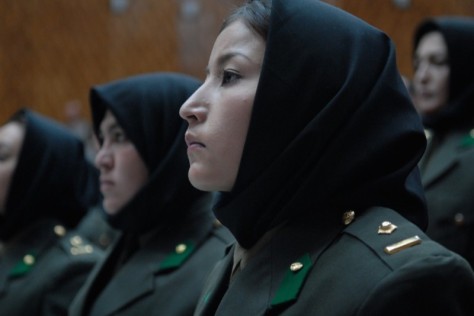
Afghanistan’s Path to Women’s Rights Is Paved With Risk, but Built on Hope · Global Voices

Rustam Ali Seeram’s report makes for difficult reading. I see only an abundance of risk and a glimmer of hope. Although it’s hard to imagine how things could be worse, sadly it seems little has changed since 2012:

“According to its menfolk the city of Gereshk was a model for gender equality and required no further encouragement from Western infidels. It already had a school for girls and even allowed women to walk the streets – albeit covered with a burkha and escorted by a male member of the family. This was quite liberal enough.

Being an infidel, I personally believed that the vast majority of social problems in Afghanistan could ultimately be traced back to the absurd practice of gender segregation. I was pretty certain that nature had intended men and women to coexist and from time to time to engage in consensual sexual intercourse. But these were radical and seditious views that had no place in Helmand.

Curiously, the Ministry of Defence also imposed strict gender segregation rules on its representatives in Helmand and banned sexual congress entirely, not as some botched attempt at cultural sensitivity, but because ‘our personnel are expected to behave in accordance with the Armed Forces values and standards at all times’. It was never clear to me which of these values and standards applied to my sex life, but since this was an entirely solitary activity anyway it was not a question that ever came up, so to speak.

Despite their liberal tendencies, the male inhabitants of Gereshk still routinely imprisoned their wives and daughters in the family compound and subjected them to appalling abuse. Josef Fritzl – ‘Das Monster von Amstetten’ – who imprisoned his daughter in the basement of his house and abused her over a 24 year period, would have been considered an upstanding member of the community. But he was already serving a life sentence in an Austrian prison for the criminally insane.

What had shocked the whole of Europe and been utterly incomprehensible in Amstetten, however inconceivable it might sound, was culturally normal activity in Helmand.”

SPIN ZHIRA: Old Man in Helmand is available as an Amazon Kindle e-book

SPIN ZHIRA: Old Man in Helmand is the true story of one man’s midlife crisis on the front line of the most dangerous district in Afghanistan where the locals haven’t forgiven the British for the occupation of 1842 or for the Russian Invasion of 1979. Of course, all infidels look the same so you can’t really tell them apart.

Fantastical and mind-boggling

David CameronDavid Cameron calls Nigeria and Afghanistan ‘fantastically corrupt’ in conversation with the Queen.

via David Cameron calls Nigeria and Afghanistan ‘fantastically corrupt’ – BBC News

As I discovered firsthand, The Prime Minister is right. Afghanistan is fantastically, mind-bogglingly corrupt:

“At the top of the list was the District Governor (DG), Salim Rodi. In addition to his role as the official representative of the people of Nahr‑E‑Saraj District, like almost all appointees of the Government of the Islamic Republic (GIRoA) he was also heavily implicated in Helmand’s narcotics industry, believed to be responsible for around 75% of global opium production.

The pressures of high office in the violent international opium business, and the even more violent business of Helmandian politics, had taken their toll and he was also a heavy drinker. Rather like Jeffrey Bernard, only with perhaps greater justification, he was frequently too unwell to perform his gubernatorial duties.

Neither his drinking nor his role in the opium trade were condoned in any of the 48 copies of the Qur’an inadvertently reduced to ashes in the Bagram incinerators. Nonetheless the Governor was outraged at the news, although he grudgingly accepted our heartfelt apology.

The DG would later claim that he personally intervened to quell a riot when ‘hundreds’ of outraged citizens marched through Gereshk in protest. Since none of our ground units or reconnaissance assets reported any unusual public gatherings I concluded that the DG was extemporising. It seemed more likely to me that having failed to foment a riot himself, perhaps because he’d been too drunk at the time, he was attempting to spin his lack of incitive powers to his advantage.

Next on the list was the District Chief of Police, the appropriately abbreviated D‑CoP, Ghullie Khan. Like his boss the Governor, the D‑CoP was predictably involved in the narcotics business. To supplement this income he also used the Afghan Uniformed Police (AUP) department he commanded to collect illegal taxes from local citizens. There were a number of ISAF apologists who defended this unlawful activity as ‘culturally normal’. I even read a paper on the subject.

Personally, I was deeply sceptical of this point of view. The truth was that ISAF seemed powerless to prevent the endemic corruption that pervaded every level of the AUP, and not a little ashamed that the primary source of these illegal taxes was a levy on the use of the main highways that bisected the district – all of which had been funded at great expense with international aid.

No one in ISAF was really sure how much the illegal taxation business was worth in Nahr‑E‑Saraj but it wasn’t petty cash. Ghullie Khan had previously been a senior police officer in the neighbouring district of Sangin. He had been removed from this post after an ISAF investigation revealed that he’d been sodomizing little boys there. In the wake of this scandal his boss, Nabi Elham – the Provincial Chief of Police – naturally promoted him to be top cop in Nahr‑E‑Saraj, although it was rumoured that he’d first demanded a bribe of half a million US dollars.

There were ISAF papers defending paedophilia and bribery as culturally normal activities too, although I didn’t waste any time reading them. Culturally normal or not, I reckoned that the citizens of those countries that had helped to fund the district’s new highways would be dismayed to learn that they were now being used to line the pockets of a known pederast, drug baron and all round bad guy.

Ghullie’s favourite son, Zaibiullah was a chip off the old block and had followed his father into the AUP. When a local shopkeeper failed to pay his taxes on time he tied his arms and legs together and drowned him into the Nahr‑E‑Buhgra canal to teach him a lesson. Such was Zaibiullah’s intellect that it was quite possible to imagine him warning the drowning man that next time he failed to pay Zaibiullah would put a bullet in his head.

It was just as possible to imagine some obscure ISAF department publishing a paper defending drowning as a culturally normal method of deterrence in much the same way that waterboarding was a culturally normal interview technique in the United States.”

SPIN ZHIRA: Old Man in Helmand is available as an Amazon Kindle e-book

SPIN ZHIRA: Old Man in Helmand is the true story of one man’s midlife crisis on the front line of the most dangerous district in Afghanistan where the locals haven’t forgiven the British for the occupation of 1842 or for the Russian Invasion of 1979. Of course, all infidels look the same so you can’t really tell them apart.

Now with Gaffer Tape

V6_BW_landscape2 with tape

In order to satisfy social media censors, SPIN ZHIRA: Old Man in Helmand now comes with Gaffer tape.

Spin Zhira Content Rating (and phallic imagery)

SPIN ZHIRA: Old Man in Helmand is available as an Amazon Kindle e-book

SPIN ZHIRA: Old Man in Helmand is the true story of one man’s midlife crisis on the front line of the most dangerous district in Afghanistan where the locals haven’t forgiven the British for the occupation of 1842 or for the Russian Invasion of 1979. Of course, all infidels look the same so you can’t really tell them apart.


Phallophoric celebration

V6_BW_landscape2

The image adorning the front cover of my SPIN ZHIRA notebook has drawn a flurry of comments – and the scrutiny of the censors.

“DURING THE FEW days I’d been away at Clifton, I discovered that in my absence someone had ‘cocked’ the notepad I’d been foolish enough to leave in plain sight on my desk.

Cocking was an obsession in the headquarters, a symptom of the sexual repression under which we all laboured. Both British and Danish commands imposed a strict no sex rule in MOB Price, which for the most part was observed. This abstinence was not the result of a commendable adherence to military discipline. Had an opportunity to engage in sexual congress presented itself I’m pretty certain that most of my colleagues, like me, would have set aside all considerations of military discipline and good order – but opportunity did not present. Price was a predominantly male, heterosexual community most of whom had wives or girlfriends waiting for them back home.

Sex, or the lack of it, was a constant preoccupation. So much so that at one of our decompression briefings in Cyprus at the end of our tour a female officer from the Royal Army Chaplains Department felt it necessary to remind us that sex involves two (or possibly more) people. By then I could hardly wait.

For the dozen or so women in Price, mostly medics and dog handlers, life in this sexually charged, testosterone fuelled environment must have been a minefield. On one occasion a female reserve officer was admonished for running wearing running shorts. This came to the attention of the chain of command who deemed it dangerously erotic. She was ordered to cease and desist immediately. In her case I had to admit they had a reasonable point, but the officer in question was incensed. When she came to seek my counsel it seemed inappropriate to compliment her on the comeliness of her gluteus maximus, so instead I offered a sympathetic ear, and tried to impress upon her the uncertain benefits of voluminous army issue shorts.

For men at their sexual peak – and even for those of us who had already passed that particular milestone – this enforced abstinence inevitably had its frustrations which were expressed in a number of ways. Cocking was one of them.

As far as I am aware this is an exclusively male obsession and involves the covert drawing of phallic imagery. This is nothing new of course. Such representations have been found dating back to the Ice Age around 28,000 years ago, and appear in many ancient cultures and religions. But the art reached new heights in MOB Price. Penis imagery would mysteriously appear on notebooks, notice boards, signage, PowerPoint presentations and operational staff work. An unusual geographical feature to the north‑east of PB Clifton was even referred to on our maps as ‘cock and balls’.

On one occasion I attended a packed briefing session in which a senior officer scribbled a note intended for Colonel James, who was sitting across the room, and handed it to the man next to him to pass down the table. By the time it reached its destination it had passed through the hands of a dozen or so officers and warrant officers, many of whom had surreptitiously cocked it. Although it was impossible to overlook the images with which it was now adorned, Colonel James accepted the note without so much as a raised eyebrow.

The towering penis that had been drawn on the front cover of my notebook was magnificent. It was a detailed and anatomically precise representation depicting an erection I’d have been justifiably proud of in my twenties and could only dream about in my forties. Phallic imagery varied considerably according to the imagination of the artist. I noticed, for example that Tom’s notebook had been illustrated with a lovingly drawn image of Winnie the Pooh being improbably penetrated by his diminutive sidekick, Piglet.

Judging from their absurdly oversized erections, which more closely resembled ancient Greek and Roman depictions of the deity Priapus than the sketches of AA Milne, they were both clearly enjoying the experience in a way that their creator had never intended.

Oh, D-D-Dear! said Piglet.

Back in civvy street, probably even back in barracks in the UK, Victorian prudishness and political correctness would not have tolerated phallic observance of this nature. HR departments would be called in, enquiries held, perpetrators reprimanded or even sacked. But in MOB Price phallophoric celebration of the Lingam, and to a lesser extent the Yoni, went unchecked.

The sexual health nurse who briefed us on RSOI had been right. None of our mucky lot was getting any and it was clearly preying on our minds.”

SPIN ZHIRA: Old Man in Helmand is the true story of one man’s midlife crisis on the front line of the most dangerous district in Afghanistan where the locals haven’t forgiven the British for the occupation of 1842 or for the Russian Invasion of 1979. Of course, all infidels look the same so you can’t really tell them apart.

SPIN ZHIRA: Old Man in Helmand is available as an Amazon Kindle e-book


District Council Elections

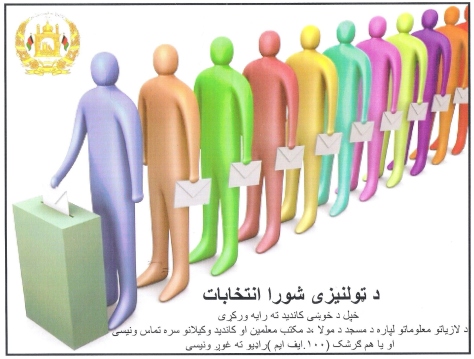
DCC Election Poster

Voters go to the polls across the UK today to elect their district councils. The democratic process was a little different in Afghanistan:

“NAHR‑E‑SARAJ IS ONE of 14 districts which make up Helmand Province. Each is governed by a council of elected officials known as the District Community Council (DCC). This was an entirely Western institution conceived by the Helmand Provincial Reconstruction Team (HPRT) and overseen by the DST. Founded in 2010, elections were to be held every couple of years when each of the mosques in the district would be entitled to select three men to represent them. These representatives would then form an electoral college who would vote on the 20 or so from their number who would actually serve as DCC councillors.

Gereshk being a shockingly liberal city, the Nahr‑E‑Saraj DCC was unique in Helmand Province in having a small number of female councillors. This was something the DST had insisted upon at the initial election and which had been grudgingly accepted by the district’s menfolk. To get around the obvious problems of actually allowing women a free vote, or the possibility that a female might defeat a male election candidate, such women as were permitted to do so by their husbands held a separate vote to select only the female councillors. On election, these token women councillors were not allowed to join their male colleagues at the council table and were authorised to debate and vote only on women’s issues. No one seemed entirely clear what these gender specific issues were, but this didn’t matter because they were never discussed.

Despite these rather obvious flaws, the DST took great pride in its female councillors. To my mind, rather than representing progress towards gender equality, they highlighted the lack of it.

It was not only women who lacked representation on the Community Council. Many of the outlying areas in the district did not have a councillor to represent them. This was because these areas were under the control of the Taliban who had not conveniently signed up to the PRT’s plan to bring democracy to Helmand Province. In fact the Taliban had so actively discouraged participation in the DCC that a few would‑be councillors had died of democracy as they slept in their beds. Somehow, the PRT managed to find the silver lining even in these assassinations by declaring that this demonstrated the ‘resilience’ of the DCC institution.

In reality, while the DST looked the other way, Balool Khan the DCC’s venerable Chairman, a former Mujahideen fighter, gifted these vacant seats to his friends and tribal allies without the need for troublesome elections and they, in turn, re‑elected him as Chairman. This way Balool retained control of the Council and ensured that his own tribesmen were first in line for any handouts from the District Development Fund. This purported to be a state fund managed by the Ministry of Finance in Kabul. It was in reality a multi‑donor international aid package less an undisclosed percentage skimmed off by Ministry of Finance mandarins. This was how democracy worked in Afghanistan and by these standards it worked very well in Nahr‑E‑Saraj.

Perhaps I should not have been surprised. The PRT was, after all, trying to overlay democracy onto a regime of tribal patronage that had been in existence long before the birth of democracy in Athens around 510BC. Balool Khan was a wise old bird and I was pretty certain that as far as he was concerned the DCC’s only purpose was to part the infidel from his money. It was fair to say that he easily out‑smarted any of the DST officials, and I had to admire his ability to run rings around them. It seemed inevitable that he would revert to the old patronage system as soon as the funding dried up.

Naturally, the Helmand PRT glossed over these failings and relentlessly communicated progress in expanding governance and the delivery of basic services, when no such progress existed.

Having imposed the DCC construct on the province two years earlier, an election was now due. Between the DST’s incompetence, Balool Khan’s contrivance and the Taliban’s intimidation the Nahr‑E‑Saraj DCC had failed from the outset to represent the people of the district but this was an ideal opportunity to redress this parlous state of affairs. Giving residents the opportunity to vote for their chosen representatives and thereby gain some influence and control over their own future might just compel them to support the GIRoA administration.

The PRT was responsible for running the election and made it very clear from the outset that they did not require, or desire, military assistance in this matter. Much to my surprise residents of the district were to be given just ten days notice of the impending election. When I raised my concerns about the brevity of this timeline, the Helmand PRT’s Governance Advisor helpfully explained to me that this was intentional. His team would not be able to cope with large numbers of citizens actually turning out to vote. In a revelatory late‑night conversation in the J9 cell he further elucidated that it was important to create the semblance of an election without going to the trouble of actually holding an election. In his opinion this would be unnecessarily bothersome and might even result in candidates considered undesirable by the PRT getting elected.

I was stunned. In part by the suspiciously racist manner in which the GOVAD appeared to view the populace of Helmand. In far greater part by the implication that American, British and Danish soldiers were risking, and losing, their lives in the district so that the PRT could create the semblance of an election.”

SPIN ZHIRA: Old Man in Helmand is the true story of one man’s midlife crisis on the front line of the most dangerous district in Afghanistan where the locals haven’t forgiven the British for the occupation of 1842 or for the Russian Invasion of 1979. Of course, all infidels look the same so you can’t really tell them apart.

SPIN ZHIRA: Old Man in Helmand is available as an Amazon Kindle e-book