
I may be getting on a bit, but I’m still ridiculously excited to be joining John Darvall tomorrow morning on BBC Radio Bristol

I may be getting on a bit, but I’m still ridiculously excited to be joining John Darvall tomorrow morning on BBC Radio Bristol
As a self-published author I’m well aware of the importance of customer reviews on the Amazon platform and I’m proud of the 50+ five star reviews that SPIN ZHIRA has attracted to date.
But SPIN ZHIRA is a minnow when compared with the 1,033 reviews that Veet for Men Hair Removal Gel has generated. Not only is it an impressive tally, but each review is an excruciating and often hilarious story of bathroom misadventure.
 In January 2012, at about the same time I set off for Afghanistan, Amazon Customer, Andrew wrote: ‘Being a loose cannon who does not play by the rules the first thing I did was ignore the warning…’ Just like Andrew, I’ve always considered myself a bit of a loose cannon, it’s how I ended up an Old Man in Helmand, but I lack his recklessness and raw courage.
35, 202 people found Andrew’s review helpful. A further 1,711 felt compelled to comment, mostly through tears of laughter and anguish. Almost everyone agrees it’s the ‘best review ever’ and a salutary lesson for us all.
SPIN ZHIRA: Old Man in Helmand is the unauthorised, unvarnished and irreverent story of one man’s midlife crisis on the front line of the most dangerous district in Afghanistan where the locals haven’t forgiven the British for the occupation of 1842 or for the Russian Invasion of 1979. Of course, all infidels look the same so you can’t really tell them apart.
 A JOURNEY OF LOVE, SERVICE AND ADVENTURE. EXCELLENT!
A MODERN WARFARE LITERARY CLASSIC! OUTSTANDING READ.
ENTERTAINING, THOUGHT-PROVOKING AND COMPULSORY TO READ.
Writing in ForeignPolicy.com, Jason Dempsey argues that the United States displayed a failure of leadership in Afghanistan.
It’s an interesting article written by an experienced former US Army officer with three tours of Afghanistan but I’m not sure I agree. It seems to assume that the military must shoulder sole responsibility for delivery of US counter-insurgency strategy in Afghanistan. It also assumes that the military machine must develop capabilities beyond conventional war fighting.
Isn’t this a bit like asking a tree surgeon if he will also do a bit of heart surgery on the side?
If the General’s failed it’s because they stepped up to the plate when no-one else was willing and were saddled with a childishly optimistic counter-insurgency strategy that assumed an inter-agency, comprehensive approach that was not forthcoming.
SPIN ZHIRA: Old Man in Helmand is the unauthorised, unvarnished and irreverent story of one man’s midlife crisis on the front line of the most dangerous district in Afghanistan where the locals haven’t forgiven the British for the occupation of 1842 or for the Russian Invasion of 1979. Of course, all infidels look the same so you can’t really tell them apart.
A JOURNEY OF LOVE, SERVICE AND ADVENTURE. EXCELLENT!
A MODERN WARFARE LITERARY CLASSIC! OUTSTANDING READ.
ENTERTAINING, THOUGHT-PROVOKING AND COMPULSORY TO READ.
Ten reasons why you should read SPIN ZHIRA.
According to the Daily Mash, Boris Johnson gets guidance on international affairs from 1970s adventure comics including Commando, Battle and Warlord.
It’s not such a terrible idea:
‘THE SWAYING OF the maize plants in the field on the opposite bank of the irrigation ditch betrays their forward movement before they break cover about 25 metres away from me.
Even before they reveal themselves I know it won’t be the 7th Cavalry – all the friendly forces in the area are on my side of the ditch. I adjust my firing position slightly, raising the optical gunsight to my right eye while simultaneously adjusting the change lever from single shot to full auto with the thumb of my left hand and depressing the safety lever to fire with the index finger of my right.
Two men dressed in khaki coloured dishdashes emerge from the field in front of me. Both wear loosely tied turbans on their heads, one black, the other a brown check material. Both carry AK47s with folding stocks. I note that neither weapon is fitted with a rear sight. Even at 25 metres this improves my odds markedly. Unable to shoulder their weapons properly with the stock folded and without an effective sighting system they will be firing in my general direction from a standing position, whereas I will be taking aimed shots from a stable prone platform. My rate of fire will be more accurate. And I will be presenting a much smaller target for them to hit.
I take up first pressure on the trigger. The difference between life and death may now be measured as 3.12kg, the precise amount of additional resistance I will need to apply to the trigger in order to release the firing mechanism.
By the way both men carry their AKs it would appear that neither is aware of my presence. For the time being at least it seems my MTP camouflage combat uniform is doing its job. This also means that I have the tactical advantage of surprise.
Despite being outnumbered 2:1 the odds are now stacked in my favour.
Through the x6 magnification of the gunsight I can see that the younger of the two, whom I’ve identified as Talib#1, wears on his left hand an ostentatious ring set with a large red ruby. I wonder if this could be a wedding band. If so, I am about to become a widowmaker.
Judging by his grey‑flecked beard, Talib#2 is not only at least a decade older than Talib#1, but will also live a little longer. It takes one to know one and I reckon the older man’s reaction times will be slower than his colleague. In practical terms this means simply that he will witness his friend’s death and have just time to register that he is himself in mortal danger before I switch fire.
I minutely adjust my position so that the orange cross‑hair of the gunsight rests on the third button of Talib#1’s dishdash. I’m going for an M or Mobility Kill rather than a K or Catastrophic Kill. A K Kill, usually a head shot, kills the target instantly. An M Kill renders the target immobile but doesn’t necessarily kill them immediately – it may take some time for them to bleed out or otherwise succumb to their wounds.
My decision is made not out of a cruel desire to inflict pain and suffering on my enemy, but a realistic appraisal of my own marksmanship skills. Outnumbered, I simply can’t risk a head shot. Even at this range I might miss. The body mass is the bigger target and will do the job I need done.
At this moment my plan does not extend beyond killing the two men in my sights. It’s enough to know that if I am going to die today, I’m not going to die alone.
I slowly exhale, and hold my breath.
It turns out that taking life, even the life of someone intent on killing you, is not as simple as the application of 3.12kg of pressure. I hesitate. At this range I will be both architect of and intimate witness to their deaths and I already know how this will play out.
From the moment I realised I was Man Away I’ve been mentally preparing for my imminent demise, at my own hand if necessary. The Talib, unaware of my presence just a few metres away, have had no time to make the same mental adjustment from hunter to hunted. The sudden shock at their change in circumstances will be replaced by a realisation that they will initially resist with each ragged, pink‑misted breath. Finally, in their last few moments of consciousness, they will reluctantly accept their fate as hopes, dreams and ambitions all slip away and their eyes dull forever.
As I waver, both men turn away from me to scan the irrigation ditch in the other direction. It doesn’t say as much in our Rules of Engagement, but I’ve read enough Battle comics as a kid to know I can’t shoot them in the back.
I have a brief vision of Harry and Alfie asking me what I’ve done in the war and admitting that I killed two men while they were looking the other way.
I know they’d both be disappointed in me.
Without breathing I wait for the men to turn back in my direction but after just a few moments they head back into the maize, returning the way they came. I continue to track their progress through the swaying field as they force their way through the giant crop until all is still.
Only then do I draw another breath.
Neither man will ever know that they owe their lives to a 1970s comic book and the moral judgement of two young boys.’
SPIN ZHIRA: Old Man in Helmand is the unauthorised, unvarnished and irreverent story of one man’s midlife crisis on the front line of the most dangerous district in Afghanistan where the locals haven’t forgiven the British for the occupation of 1842 or for the Russian Invasion of 1979. Of course, all infidels look the same so you can’t really tell them apart.
A JOURNEY OF LOVE, SERVICE AND ADVENTURE. EXCELLENT!
A MODERN WARFARE LITERARY CLASSIC! OUTSTANDING READ.
ENTERTAINING, THOUGHT-PROVOKING AND COMPULSORY TO READ.
Lily Allen has been heavily criticised for apologising to an Afghan boy at the Sangatte refugee camp outside Calais: ‘On behalf of my country, I’m sorry for what we have put you through. We’ve bombed your country, put you in the hands of the Taliban and now put you in danger of risking your life to get into our country.’
Conservative MP, Philip Davies branded Allen a ‘luvvie’ while Colonel Richard Kemp, who commanded British forces in Afghanistan in 2003, said ‘she clearly does not have any understanding of the situation.’
It’s true that Lily Allen has no mandate to represent the British people, so I can see why Mr Davies might be irritated – that’s his job after all. But I’m frankly alarmed by Colonel Kemp’s remarks because they expose his own lack of understanding – and he’s supposed to be an expert.
It seems to me that Lily Allen understands the situation perfectly. In the early days of the campaign British airstrikes devastated many towns and villages in Helmand, causing high civilian casualties and forcing the local population they were supposed to be protecting to flee. Today, almost all the ground once controlled by British troops has been ceded to the Taliban with Lashkar Gah, the former headquarters for Task Force Helmand under siege.
She might be a luvvie but if you ask me Lily Allen knows what she’s talking about.
SPIN ZHIRA: Old Man in Helmand is the unauthorised, unvarnished and irreverent story of one man’s midlife crisis on the front line of the most dangerous district in Afghanistan where the locals haven’t forgiven the British for the occupation of 1842 or for the Russian Invasion of 1979. Of course, all infidels look the same so you can’t really tell them apart.
A JOURNEY OF LOVE, SERVICE AND ADVENTURE. EXCELLENT!
A MODERN WARFARE LITERARY CLASSIC! OUTSTANDING READ.
ENTERTAINING, THOUGHT-PROVOKING AND COMPULSORY TO READ.
Stephen Carlson served two tours in Afghanistan as an infantryman with the 10th Mountain Division. Writing in the Washington Post he sums up the collective dilemma that is Afghanistan: ‘I can understand why no one else knows what is going on there, because after 15 years and two tours I still don’t know.’
Even after 15 years the international community has no idea what to do. It clings to a failed counter-insurgency doctrine, continues to pour billions of dollars of aid into the country and routinely trots out meaningless platitudes that are, at best, a gross distortion of the truth. Meanwhile, Helmand Province remains a key trade centre in the global illegal opium trade as the country continues to descend into civil war.
Nothing can change until we are at least honest with ourselves about past mistakes. But too many political and military reputations are at stake for this to happen anytime soon.
SPIN ZHIRA: Old Man in Helmand is the unauthorised, unvarnished and irreverent story of one man’s midlife crisis on the front line of the most dangerous district in Afghanistan where the locals haven’t forgiven the British for the occupation of 1842 or for the Russian Invasion of 1979. Of course, all infidels look the same so you can’t really tell them apart.
A JOURNEY OF LOVE, SERVICE AND ADVENTURE. EXCELLENT!
A MODERN WARFARE LITERARY CLASSIC! OUTSTANDING READ.
ENTERTAINING, THOUGHT-PROVOKING AND COMPULSORY TO READ.
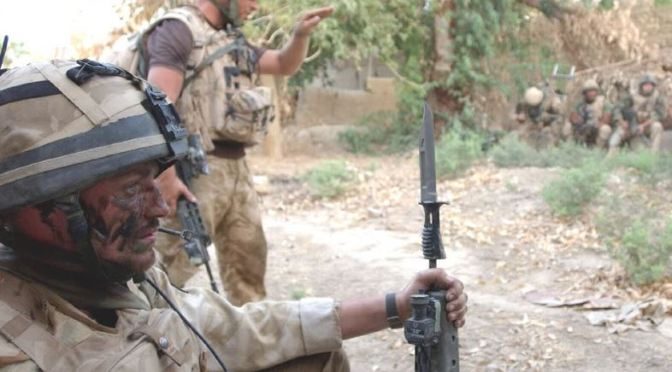
Five years ago this month, Corporal Sean Jones of C Company, the Princess of Wales Royal Regiment led a bayonet charge, along with three other men, onto a Taliban position in the village of Kakoran.
Corporal Jones’ action that day earned him a well deserved Military Cross for ‘extraordinary leadership in the face of extreme and tangible danger’.
He would later state that the way his patrol dealt with the Taliban also improved relations with the villagers they were trying to protect. ‘Before this, the locals were wary of us, but this showed they could trust us to protect them from the enemy and that we wouldn’t endanger them while doing it… We built good relationships, chatting to them on patrols, kicking balls around with the children. They knew the Taliban could no longer enforce curfews on them and things got much better with their way of life.’

Sadly, any improvements were short-lived. Five months later I would join the men of C Company on their last patrol into Kakoran:
‘Patrol Base Clifton sits atop high ground just outside the green zone overlooking a rural community which has not changed much in the last 500 years. Families live in walled compounds made of mud and straw, side by side with their livestock. They have none of the creature comforts we take for granted in the West. Despite these privations it has a certain rustic beauty. Fields are carefully tended, watered by a delicate and intricate irrigation system which provides an ever‑present, soothing soundtrack of flowing water. Whitewashed compounds are shaded by magnificent mulberry trees which stave off the relentless heat of the Afghan summer.
In stark contrast to the dashte in the north, the land is fertile. The favourable climate and an abundance of water enable three growing seasons each year. Farmers harvest poppy in April, wheat in June and maize in September. Poppy, however, is the main source of income and this illicit trade binds the community to an insurgent narco‑nexus which facilitates the movement of wet opium to markets in Gereshk, and as far afield as Pakistan and Iran.
Over the past six months C Company has made numerous attempts to gain access to Kakoran and its sister kalay of Narqiel a few clicks further south. All have resulted in ‘kinetic activity’ – the military euphemism for the use of lethal force. Further east in the kalay of Adinzai insurgents have been observed routinely gathering at a tea shop in the local bazaar, openly carrying their weapons without fear of reprisals. This group of young bandits is known to be especially wild and fond of violence and is informally labelled the ‘Crazy Gang’ by our J2 (Intelligence) cell.
Back in the UK Captain Alex Bayliss, our Intelligence Officer had described this area to me as the ‘Taliban Heart of Darkness’. It’s a place where brown underpants are a sensible precaution.
We continue to patrol down into the green zone where we go firm on the side of a dirt road beside an Afghan National Army (ANA) checkpoint which is surrounded on all sides by poppy fields. The ANA lads look bored, wandering around in flip‑flops and t‑shirts, pretending to ignore what we’re up to. Someone is preparing a meal while another man splits logs with a lump hammer and a metal stake. No one is manning the machine gun or carrying weapons.
A battered white Nissan pulls up and five or six lads get out. Although they’re in civvies they’re obviously part of the gang. There’s lots of hugging and fast talking. I’m curious to know how an ANA soldier can afford to own a motor vehicle but I keep that thought to myself. In the distance I see men labouring in the poppy fields in a slow, measured way that suggests they’re pacing themselves for a lifetime of hard manual labour. Nothing much has changed here for centuries it seems, so there’s no great rush to get anything done.
It’s obvious that everyone is watching us and waiting to see what our next move will be. After about 30 minutes we’re given the order to move and head out across the fields towards some compounds about 200 metres distant. We’re following a safe lane cleared by a Vallon operator and marked by his number two with blue spray paint. It’s a slow but essential process; Improvised Explosive Devices (IEDs) are the insurgents’ weapon of choice and the number one source of ‘Category A’ casualties amongst ISAF and ANA soldiers. A Cat A is defined as a life threatening injury which requires urgent medical attention within 90 minutes.
At first the going is pretty straightforward but as we move deeper into the green zone the ground becomes heavily waterlogged. Progress gets tougher and tougher as mud oozes over the tops of our boots, then up to our knees. It’s almost impossible to mark a safe lane in this sea of liquid mud but I take consolation from the fact that it would be equally near impossible to maintain the integrity of a battery pack, an essential component of any IED, in this volume of water.
By the time we reach the tree line I’m blowing hard and covered in filth – there’s a dodgy stench about me that may or may not be human excrement, which the locals routinely recycle onto their fields. I try not to think about it. Grateful for the camelback I was issued at the Reserve Training and Mobilisation Centre in Chilwell, Nottingham, I suck down some deliciously cool water through the drinking tube clipped to the front of my body armour.
We go firm in the tree line and scan our arcs. There are plenty of local nationals who have come out to watch the show. For us it’s a good sign because it suggests that the insurgents haven’t warned them to stay away, but we’re not letting down our guard. A number of shifty looking blokes of fighting age are having a bit of a chin wag about 300 metres away. One of them is clearly talking into a mobile phone. A couple of motorbikes are also whizzing up and down a track on our left and appear to be keeping tabs on our movements.
In order to get a clearer picture of what’s going on we decide to push forward across another field, but first we have to cross an irrigation ditch. It’s full of waist deep murky brown water with steep banks on either side. There’s no way to jump across with all the kit we’re carrying. In any case it’s a vulnerable point which will have to be cleared by the Vallon.
The insurgents are experts at identifying likely crossing points such as this and placing IEDs in the banks to catch unwary soldiers as they climb in or out. As we clear the ditch the guy behind me struggles to find a foothold on the slippery bank. I lend him a hand and he nearly pulls my arm from its socket as he hauls himself out. Unbalanced, I take a step backwards and stumble before falling headlong down the other side of the bank. I try desperately to stay in the safe lane but to no avail. We’ve been told that 90% of IED casualties are caused by straying out of lane. This time my luck holds but my underpants are going to require an intensive wash cycle.
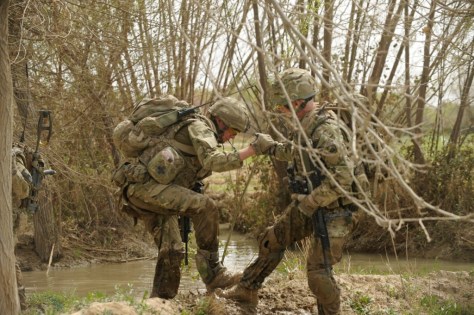
In the short time it’s taken us to clear the ditch the atmospherics have changed. Women and children can be seen fleeing from the two compounds immediately to our front, herding their livestock in front of them. The likely lads we saw earlier have now split into two groups. One of our blokes sees what he thinks is a long‑barrelled weapon being taken into one of the compounds. These are all sure fire indicators that we’re about to be taken on and we now assess these two compounds to be the most likely direction of any threat.
In a procedure the C Company men call ‘advance to ambush’ we continue to move towards the compounds, expecting to come under fire at any moment. I repeatedly check the safety catch on my assault rifle with the index finger of my right hand but resist the temptation to slip it to ‘off’. Unless I’m unlucky enough to be hit by the initial burst of fire, in which case it’ll make no difference anyway, there’ll be plenty of time to depress the safety as I sight the weapon.
In these moments my focus on the compound is absolute. I no longer register the smell of human excrement encrusted on my combat trousers or the pain of blisters forming inside my waterlogged boots. I am unaware of the weight of my backpack compressing the blood supply to my left arm or the constant chafing of ballistic plates over my salt‑rimed skin.
My existence has narrowed to a set of binary choices: Live or die; hunt or be hunted; kill or be killed. These moments are the culmination of hundreds, if not thousands of hours of training which have consumed almost every waking hour of my life for the past 18 months. It is for these few precious minutes that I’ve turned my back on a lucrative career, abandoned my comfortable suburban existence, my beautiful wife, my trophy house, my exotic bi‑annual holidays.
I‘m not disappointed. The simplicity is exhilarating.
I’m taking a long hard look at the compound wall, trying to identify any likely firing points or murder holes, when there is a huge explosion. My first thought is that one of us has initiated an IED but then I see smoke billowing from the compound. Perhaps it’s an IED own goal.
But less than 30 seconds later I hear the distinctive sound of rotor blades and turn to see an Apache attack helicopter approach from behind us at about 500 feet. It has fired a Hellfire missile right through the open window of the compound’s main building. Now it follows up with a long burst of 30mm cannon. I take a knee and watch as the building appears to disintegrate into a cloud of dust in front of us.
After the intensity of the preceding moments I feel strangely impassive but, given that we are between the Apache and its target, it crosses my mind that now would not be a good time for the pilot to sneeze.
We learn later that, undetected by us or by the likely lads, the Apache pilot had come on station a few minutes earlier. From his vantage point, unseen and unheard five klicks behind and above us, the pilot had been able to see what we could not see from less than 150 metres away on the ground. He had positively identified two shooters about to open fire and under ISAF rules of engagement he had permission to make a pre‑emptive strike on the basis of imminent threat to life. In this case our lives.’
It was to be the first of many patrols I would make into Kakoran and the surrounding area. Over the course of the next few months four Guardsmen would be killed and many others wounded in action there, often in bitter close quarter combat.
History shows that the locals were right to be wary of ISAF soldiers. We proved unable to protect them and even before the British departure from Helmand Province in 2014, Kakoran returned to Taliban shadow governance. GIRoA has no presence or authority there.
SPIN ZHIRA: Old Man in Helmand is the unauthorised, unvarnished and irreverent story of one man’s midlife crisis on the front line of the most dangerous district in Afghanistan where the locals haven’t forgiven the British for the occupation of 1842 or for the Russian Invasion of 1979. Of course, all infidels look the same so you can’t really tell them apart.
A JOURNEY OF LOVE, SERVICE AND ADVENTURE. EXCELLENT!
A MODERN WARFARE LITERARY CLASSIC! OUTSTANDING READ.
ENTERTAINING, THOUGHT-PROVOKING AND COMPULSORY TO READ.
Ten reasons why you should read SPIN ZHIRA.
Reports from Islamabad indicate that the Taliban have stepped up their offensive on the strategically important city of Lashkar Gah in Helmand Province with fighting on several fronts.
Once the Task Force Helmand headquarters, and universally known simply as ‘Lash’ to British troops, it is an alarming marker of failure that the city formerly at the epicentre of the UK’s commitment in Afghanistan is now in danger of falling to the Taliban just two years after the British departed.
While Lash has been under siege for many weeks this new offensive comes just days after Priti Patel, the Secretary of State for International Development claimed: ‘The UK’s presence in Afghanistan over the last decade has helped improve security and prevent it from once again becoming a base of operations for global terrorists that would threaten the streets of Britain.’
SPIN ZHIRA: Old Man in Helmand is the unauthorised, unvarnished and irreverent story of one man’s midlife crisis on the front line of the most dangerous district in Afghanistan where the locals haven’t forgiven the British for the occupation of 1842 or for the Russian Invasion of 1979. Of course, all infidels look the same so you can’t really tell them apart.
A JOURNEY OF LOVE, SERVICE AND ADVENTURE. EXCELLENT!
A MODERN WARFARE LITERARY CLASSIC! OUTSTANDING READ.
ENTERTAINING, THOUGHT-PROVOKING AND COMPULSORY TO READ.
What others are saying about SPIN ZHIRA
Speaking to The Guardian, Neil MacGregor, the former director of the British Museum, has bemoaned Britain’s narrow view of its own history, calling it “dangerous and regrettable” for focusing almost exclusively on the “sunny side”.
Speaking before the Berlin opening of his highly popular exhibition Germany – Memories of a Nation, MacGregor expressed his admiration for Germany’s rigorous appraisal of its history which he said could not be more different to that of Britain.
This selective view is not just confined to our history but also our recent past and, worst still, our present.
In Afghanistan in 2012, we were all guilty of earnestly pronouncing progress and proclaiming ‘cautious optimism’ for the future. None more so than the Department for International Development (DfID). Even last week, Priti Patel, in the face of overwhelming evidence to the contrary claimed ‘The UK’s presence in Afghanistan over the last decade has helped improve security and… improved the lives of Afghans significantly’.
It’s interesting that MacGregor contrasts the British approach to history with that of Germany. In September 1941 Joseph Goebbels wrote: ‘The English follow the principle that when one lies, one should lie big, and stick to it. They keep up their lies, even at the risk of looking ridiculous.’
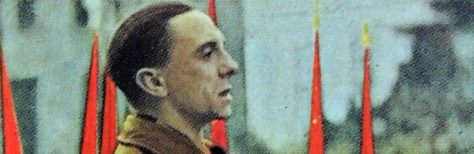
Modern Germany does not shy away from its Nazi past but, while it may or may not have been true at the time, Goebbels’ assertion now seems uncomfortably prescient.
SPIN ZHIRA: Old Man in Helmand is the unauthorised, unvarnished and irreverent story of one man’s midlife crisis on the front line of the most dangerous district in Afghanistan where the locals haven’t forgiven the British for the occupation of 1842 or for the Russian Invasion of 1979. Of course, all infidels look the same so you can’t really tell them apart.
A JOURNEY OF LOVE, SERVICE AND ADVENTURE. EXCELLENT!
A MODERN WARFARE LITERARY CLASSIC! OUTSTANDING READ.
ENTERTAINING, THOUGHT-PROVOKING AND COMPULSORY TO READ.
SPIN ZHIRA: Old Man in Helmand is the unauthorised, unvarnished and irreverent story of one man’s midlife crisis on the front line of the most dangerous district in Afghanistan where the locals haven’t forgiven the British for the occupation of 1842 or for the Russian Invasion of 1979. Of course, all infidels look the same so you can’t really tell them apart.

Here are ten reasons why you should read it:
A JOURNEY OF LOVE, SERVICE AND ADVENTURE. EXCELLENT!
A MODERN WARFARE LITERARY CLASSIC! OUTSTANDING READ.
ENTERTAINING, THOUGHT-PROVOKING AND COMPULSORY TO READ.






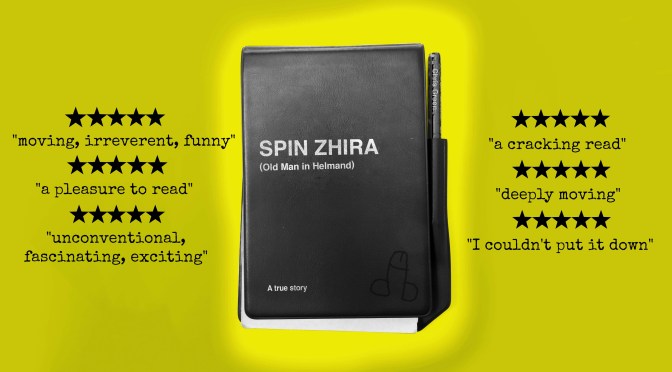
 SPIN ZHIRA